Determine whether the following statements are true and give an explanation or counterexample. c. The terms of the sequence of partial sums of the series ∑ aₖ approach 5/2, so the infinite series converges to 5/2.
Verified step by step guidance
1
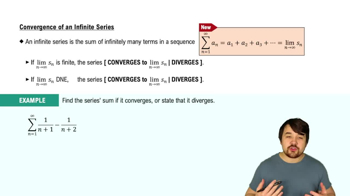
Recall that the sequence of partial sums \( S_n = \sum_{k=1}^n a_k \) represents the sum of the first \( n \) terms of the series \( \sum a_k \).
If the terms of the sequence of partial sums \( S_n \) approach a limit \( L \) as \( n \to \infty \), then the infinite series \( \sum a_k \) converges to \( L \).
In this problem, it is given that the terms of the sequence of partial sums approach \( \frac{5}{2} \). This means \( \lim_{n \to \infty} S_n = \frac{5}{2} \).
Since the partial sums approach \( \frac{5}{2} \), by definition, the infinite series \( \sum a_k \) converges and its sum is \( \frac{5}{2} \).
Therefore, the statement is true because the convergence of the partial sums to \( \frac{5}{2} \) directly implies the series converges to \( \frac{5}{2} \).
Verified video answer for a similar problem:
This video solution was recommended by our tutors as helpful for the problem above
Video duration:
2m
Play a video:
0 Comments
Key Concepts
Here are the essential concepts you must grasp in order to answer the question correctly.
Sequence of Partial Sums
The sequence of partial sums is formed by adding the first n terms of a series. It helps analyze the behavior of the series by examining the limit of these sums as n approaches infinity.
An infinite series converges if the sequence of its partial sums approaches a finite limit. This limit is the sum of the series, meaning the series adds up to a specific value.
The limit of a sequence is the value that the terms of the sequence get arbitrarily close to as the index grows large. If the partial sums approach 5/2, the series converges to 5/2.