Explain why or why not Determine whether the following statements are true and give an explanation or counterexample.
d. Every partial sum Sₙ of the series ∑ (k = 1 to ∞) 1 / k² underestimates the exact value of ∑ (k = 1 to ∞) 1 / k².
Verified step by step guidance
1
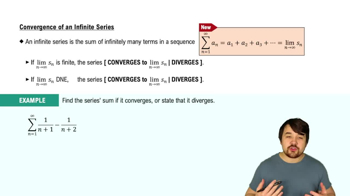
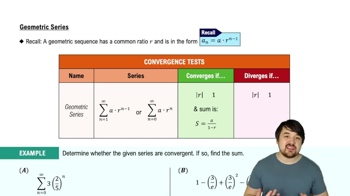
Recall that the series \( \sum_{k=1}^\infty \frac{1}{k^2} \) is a convergent series with positive terms, known as the p-series with \( p = 2 > 1 \).
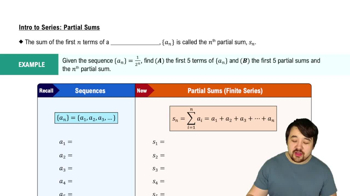
The partial sum \( S_n = \sum_{k=1}^n \frac{1}{k^2} \) represents the sum of the first \( n \) terms of the series.
Since all terms \( \frac{1}{k^2} > 0 \), the sequence of partial sums \( S_n \) is strictly increasing, meaning \( S_1 < S_2 < S_3 < \cdots \).
Because the series converges to a finite limit \( S = \sum_{k=1}^\infty \frac{1}{k^2} \), and the partial sums increase towards this limit, each partial sum \( S_n \) must be less than or equal to \( S \).
Therefore, every partial sum \( S_n \) underestimates the exact value of the infinite series \( \sum_{k=1}^\infty \frac{1}{k^2} \), making the statement true.
Verified video answer for a similar problem:
This video solution was recommended by our tutors as helpful for the problem above
Video duration:
1m
Play a video:
0 Comments
Key Concepts
Here are the essential concepts you must grasp in order to answer the question correctly.
Partial Sums of Infinite Series
A partial sum Sₙ is the sum of the first n terms of an infinite series. It approximates the total sum, and understanding how these sums behave helps determine if they overestimate or underestimate the series' exact value.
A series converges if its partial sums approach a finite limit. For series with positive, decreasing terms like 1/k², partial sums are increasing and approach the limit from below, which affects whether they underestimate or overestimate the total sum.
To verify statements about series, one uses comparison tests or constructs counterexamples. For the series ∑ 1/k², known results and inequalities help confirm if partial sums underestimate the total sum or not.