Explain why or why not Determine whether the following statements are true and give an explanation or counterexample.
b. A series that converges absolutely must converge.
Verified step by step guidance
1
Recall the definition of absolute convergence: A series \( \sum a_n \) converges absolutely if the series of absolute values \( \sum |a_n| \) converges.
Understand that absolute convergence implies convergence because if \( \sum |a_n| \) converges, then \( \sum a_n \) also converges (this is a standard theorem in series analysis).
Explain that the intuition behind this is that the terms \( a_n \) are controlled in size by their absolute values, so if the absolute values sum to a finite number, the original series cannot diverge.
Note that this is different from conditional convergence, where \( \sum a_n \) converges but \( \sum |a_n| \) does not converge.
Conclude that the statement 'A series that converges absolutely must converge' is true, and the reasoning is based on the comparison between the series and its absolute value series.
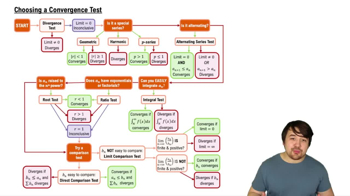
Verified video answer for a similar problem:
This video solution was recommended by our tutors as helpful for the problem above
Video duration:
58s
Play a video:
0 Comments
Key Concepts
Here are the essential concepts you must grasp in order to answer the question correctly.
Absolute Convergence
A series is absolutely convergent if the series of the absolute values of its terms converges. This means that when you ignore the signs of the terms, the sum still approaches a finite limit. Absolute convergence is a stronger condition than regular convergence.
A series converges conditionally if it converges, but does not converge absolutely. This means the series converges only when considering the signs of the terms, and the series of absolute values diverges. Conditional convergence highlights the importance of term signs in convergence.
Implication of Absolute Convergence on Convergence
If a series converges absolutely, it must also converge in the usual sense. Absolute convergence guarantees convergence because the terms' magnitudes shrink sufficiently fast. This is a fundamental theorem in series analysis, ensuring absolute convergence implies convergence.

 0:58 minutes
 Verified step by step guidance
 07:51
07:51