11–27. Alternating Series Test Determine whether the following series converge. ∑ (k = 2 to ∞) (−1)ᵏ (1 + 1/k)
Verified step by step guidance
1
Identify the general term of the series: \( a_k = (-1)^k \left(1 + \frac{1}{k}\right) \). This is an alternating series because of the factor \((-1)^k\), which causes the terms to alternate in sign.
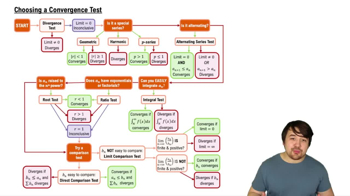
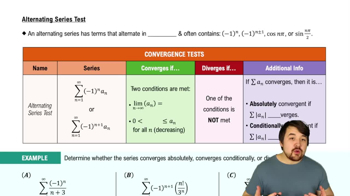
Recall the Alternating Series Test (Leibniz Test), which states that an alternating series \( \sum (-1)^k b_k \) converges if two conditions are met: (1) the sequence \( b_k \) is positive, decreasing, and (2) \( \lim_{k \to \infty} b_k = 0 \).
Rewrite the series terms without the alternating sign to identify \( b_k \): \( b_k = 1 + \frac{1}{k} \). Note that \( b_k \) must be positive and decreasing for the test to apply.
Check if \( b_k = 1 + \frac{1}{k} \) is decreasing. Since \( 1 + \frac{1}{k} \) decreases as \( k \) increases, verify this by comparing \( b_k \) and \( b_{k+1} \).
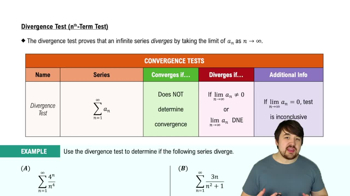
Evaluate the limit \( \lim_{k \to \infty} b_k = \lim_{k \to \infty} \left(1 + \frac{1}{k}\right) \). If this limit is zero, the series converges by the Alternating Series Test; if not, the test fails and the series diverges.
Verified video answer for a similar problem:
This video solution was recommended by our tutors as helpful for the problem above
Video duration:
2m
Play a video:
0 Comments
Key Concepts
Here are the essential concepts you must grasp in order to answer the question correctly.
Alternating Series Test
The Alternating Series Test determines if a series with terms alternating in sign converges. It requires that the absolute value of the terms decreases monotonically to zero. If these conditions hold, the series converges, even if it does not converge absolutely.
Analyzing the general term (1 + 1/k) is crucial to check if it approaches zero as k approaches infinity. For convergence of an alternating series, the terms must tend to zero; if they do not, the series diverges regardless of sign alternation.
Absolute convergence occurs if the series of absolute values converges, implying stronger convergence. Conditional convergence happens when the alternating series converges but the absolute series diverges. Understanding this distinction helps classify the series' convergence type.

 2:31 minutes
 Verified step by step guidance
 10:54
10:54