Explain why or why not Determine whether the following statements are true and give an explanation or counterexample.
a. A series that converges must converge absolutely.
Verified step by step guidance
1
Recall the definitions: A series \( \sum a_n \) converges absolutely if \( \sum |a_n| \) converges, and it converges conditionally if \( \sum a_n \) converges but \( \sum |a_n| \) diverges.
Understand that absolute convergence implies convergence, but the converse is not necessarily true.
Consider the alternating harmonic series \( \sum (-1)^{n+1} \frac{1}{n} \), which converges by the Alternating Series Test but does not converge absolutely because \( \sum \frac{1}{n} \) diverges.
This example shows that a series can converge without converging absolutely, so the statement 'A series that converges must converge absolutely' is false.
Therefore, the correct conclusion is that convergence does not imply absolute convergence; some series converge conditionally.
Verified video answer for a similar problem:
This video solution was recommended by our tutors as helpful for the problem above
Video duration:
1m
Play a video:
0 Comments
Key Concepts
Here are the essential concepts you must grasp in order to answer the question correctly.
Convergence of a Series
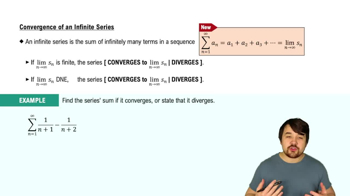
A series converges if the sequence of its partial sums approaches a finite limit. This means the sum of infinitely many terms settles to a specific value, indicating the series has a well-defined total.
A series converges absolutely if the series formed by taking the absolute values of its terms also converges. Absolute convergence guarantees convergence and often simplifies analysis, especially for series with both positive and negative terms.
A series is conditionally convergent if it converges but does not converge absolutely. The alternating harmonic series is a classic example, showing that convergence does not imply absolute convergence, which is crucial for evaluating the truth of the statement.