Start by examining the integral \( \int \frac{dx}{x^{2} + 25x} \). Notice that the denominator can be factored as \( x(x + 25) \).
Rewrite the integral using the factorization: \( \int \frac{dx}{x(x + 25)} \). This suggests using partial fraction decomposition to simplify the integrand.
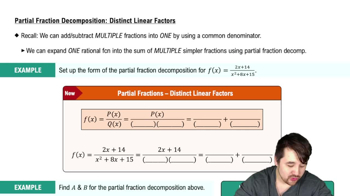
Set up the partial fractions: \( \frac{1}{x(x + 25)} = \frac{A}{x} + \frac{B}{x + 25} \). Multiply both sides by \( x(x + 25) \) to find \( A \) and \( B \).
Solve for \( A \) and \( B \) by substituting convenient values for \( x \) (such as \( x = 0 \) and \( x = -25 \)) or by equating coefficients.
Once you have \( A \) and \( B \), rewrite the integral as \( \int \left( \frac{A}{x} + \frac{B}{x + 25} \right) dx \) and integrate each term separately using the natural logarithm function.
Verified video answer for a similar problem:
This video solution was recommended by our tutors as helpful for the problem above
Video duration:
4m
Play a video:
0 Comments
Key Concepts
Here are the essential concepts you must grasp in order to answer the question correctly.
Integration of Rational Functions
This involves integrating functions expressed as ratios of polynomials. Techniques such as partial fraction decomposition are often used to simplify the integrand into manageable terms that can be integrated directly.
A method to break down complex rational expressions into simpler fractions. It is especially useful when the denominator factors into linear or quadratic terms, allowing easier integration of each component.
Partial Fraction Decomposition: Distinct Linear Factors
Algebraic Manipulation and Substitution
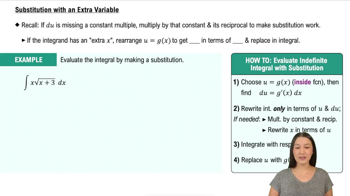
Rewriting expressions, such as recognizing that √(x² + 25x) = √x √(x + 25), helps simplify the integral. Substitution techniques can then be applied to transform the integral into a standard form for easier evaluation.