66. Integrating derivatives Use integration by parts to show that if f' is continuous on [a, b], then ∫[a to b] f(x)f'(x) dx = (1/2)[f(b)² - f(a)²]
Verified step by step guidance
1
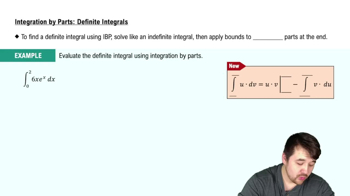
Recall the integration by parts formula: \(\int_a^b u(x) v'(x) \, dx = \left[ u(x) v(x) \right]_a^b - \int_a^b u'(x) v(x) \, dx\).
Choose \(u(x) = f(x)\) and \(v'(x) = f'(x)\), so that \(u'(x) = f'(x)\) and \(v(x)\) is an antiderivative of \(f'(x)\), which is \(f(x)\) since \(f'\) is the derivative of \(f\).
Substitute into the integration by parts formula: \(\int_a^b f(x) f'(x) \, dx = \left[ f(x) f(x) \right]_a^b - \int_a^b f'(x) f(x) \, dx\).
Notice that the integral on the right side is the same as the original integral, so denote \(I = \int_a^b f(x) f'(x) \, dx\). Then the equation becomes \(I = \left[ f(x)^2 \right]_a^b - I\).
Solve for \(I\) by adding \(I\) to both sides: \$2I = f(b)^2 - f(a)^2$, and then divide both sides by 2 to get \(I = \frac{1}{2} \left[ f(b)^2 - f(a)^2 \right]\).
Verified video answer for a similar problem:
This video solution was recommended by our tutors as helpful for the problem above
Video duration:
1m
Play a video:
0 Comments
Key Concepts
Here are the essential concepts you must grasp in order to answer the question correctly.
Integration by Parts
Integration by parts is a technique derived from the product rule of differentiation. It transforms the integral of a product of functions into simpler integrals, using the formula ∫u dv = uv - ∫v du. This method is essential for solving integrals where direct integration is difficult.
If f' is continuous on [a, b], it ensures that f is differentiable and smooth on that interval. Continuity of f' allows the application of the Fundamental Theorem of Calculus and guarantees the integrals and manipulations involving f and f' are valid and well-defined.
Relationship Between a Function and Its Derivative in Integration
The integral ∫ f(x) f'(x) dx can be interpreted as integrating a function times its derivative. Recognizing this relationship helps simplify the integral by expressing it as a derivative of a composite function, such as (f(x))², which leads to the result involving the difference of squares at the boundaries.