12–24. Limits of sequences Evaluate the limit of the sequence or state that it does not exist. aₙ = 8ⁿ / n!
Verified step by step guidance
1
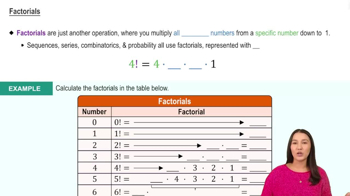
Identify the sequence given: \(a_n = \frac{8^n}{n!}\), where \(n!\) denotes the factorial of \(n\).
Recall that factorial \(n!\) grows much faster than any exponential function \$8^n\( as \)n$ becomes very large.
To analyze the limit \(\lim_{n \to \infty} \frac{8^n}{n!}\), consider the behavior of the terms in the denominator compared to the numerator as \(n\) increases.
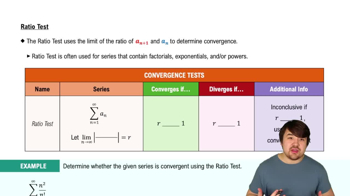
Use the ratio test for sequences by examining the ratio \(\frac{a_{n+1}}{a_n} = \frac{8^{n+1}/(n+1)!}{8^n/n!} = \frac{8}{n+1}\), which approaches 0 as \(n \to \infty\).
Since the ratio approaches 0, the terms \(a_n\) get smaller and smaller, indicating that the limit of the sequence is 0.
Verified video answer for a similar problem:
This video solution was recommended by our tutors as helpful for the problem above
Video duration:
2m
Play a video:
0 Comments
Key Concepts
Here are the essential concepts you must grasp in order to answer the question correctly.
Limits of Sequences
The limit of a sequence describes the value that the terms of the sequence approach as the index n becomes very large. If the terms get arbitrarily close to a specific number, the sequence converges to that limit; otherwise, it diverges.
Factorials (n!) grow much faster than exponential functions like 8ⁿ as n increases. Understanding this difference in growth rates helps determine the behavior of sequences involving factorials and exponentials.
The ratio test compares the ratio of consecutive terms aₙ₊₁ / aₙ to analyze the limit of a sequence. If this ratio approaches a value less than 1, the sequence tends to zero, aiding in evaluating limits involving factorials and exponentials.