72–86. Evaluating series Evaluate each series or state that it diverges. ∑ (k = 0 to ∞) (1/4)ᵏ × 5^(3 – k)
Verified step by step guidance
1
Identify the general term of the series: \( a_k = \left(\frac{1}{4}\right)^k \times 5^{3-k} \).
Rewrite the term to express it as a single base raised to the power \(k\): \( a_k = 5^3 \times \left(\frac{1}{4} \times \frac{1}{5}\right)^k = 125 \times \left(\frac{1}{20}\right)^k \).
Recognize that the series is a geometric series with first term \( a_0 = 125 \) and common ratio \( r = \frac{1}{20} \).
Check the convergence of the geometric series by verifying if \( |r| < 1 \). Since \( \frac{1}{20} < 1 \), the series converges.
Use the formula for the sum of an infinite geometric series: \( S = \frac{a_0}{1 - r} = \frac{125}{1 - \frac{1}{20}} \) to express the sum.
Verified video answer for a similar problem:
This video solution was recommended by our tutors as helpful for the problem above
Video duration:
3m
Play a video:
0 Comments
Key Concepts
Here are the essential concepts you must grasp in order to answer the question correctly.
Geometric Series
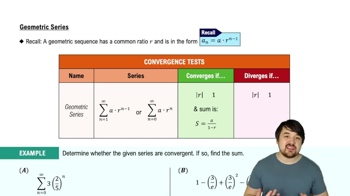
A geometric series is a sum of terms where each term is found by multiplying the previous term by a constant ratio. It has the form ∑ ar^k, and converges if the absolute value of the ratio |r| < 1. The sum can be calculated using the formula S = a / (1 - r).
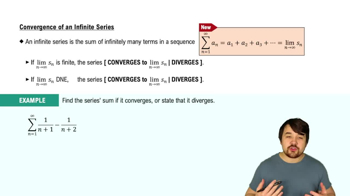
An infinite series converges if the sum approaches a finite limit as the number of terms increases indefinitely. If it does not approach a finite value, the series diverges. Determining convergence is essential before evaluating the sum of an infinite series.
Simplifying the general term of a series often involves algebraic manipulation, such as factoring constants or rewriting terms with exponents. This helps identify the type of series and the common ratio, facilitating the application of convergence tests and sum formulas.