

Ch. 2 - Limits and Continuity
Hass - Thomas' Calculus 15th Edition
Hass15th EditionThomas' CalculusISBN: 9780137616077Not the one you use?Change textbook
Chapter 2, Problem 2.5.42

Define h(2) in a way that extends h(t) = (t² + 3t − 10)/(t − 2) to be continuous at t = 2.

Verified step by step guidance
1
First, identify the function h(t) = (t² + 3t − 10)/(t − 2). Notice that the denominator becomes zero when t = 2, which makes the function undefined at this point.
To extend h(t) to be continuous at t = 2, we need to find the limit of h(t) as t approaches 2. This involves simplifying the expression to remove the discontinuity.
Factor the numerator t² + 3t − 10. Look for two numbers that multiply to -10 and add to 3. These numbers are 5 and -2, so the factorization is (t + 5)(t - 2).
Substitute the factorized form into the function: h(t) = ((t + 5)(t - 2))/(t - 2). Notice that the (t - 2) terms cancel out, simplifying the function to h(t) = t + 5 for t ≠ 2.
Now, find the limit of h(t) as t approaches 2 using the simplified function: lim(t→2) (t + 5). This limit will give the value of h(2) that makes the function continuous at t = 2.

Verified video answer for a similar problem:

This video solution was recommended by our tutors as helpful for the problem above.
Video duration:
2m
Was this helpful?

Key Concepts

Here are the essential concepts you must grasp in order to answer the question correctly.

Limits

Limits are fundamental in calculus, representing the value that a function approaches as the input approaches a certain point. To define h(2) for continuity, we need to evaluate the limit of h(t) as t approaches 2. If this limit exists, it can be used to assign a value to h(2) that makes the function continuous at that point.
Recommended video:
05:50
One-Sided Limits

Continuity

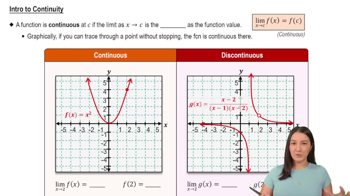
A function is continuous at a point if the limit of the function as it approaches that point equals the function's value at that point. For h(t) to be continuous at t = 2, we must ensure that h(2) is defined and equals the limit of h(t) as t approaches 2. This ensures there are no breaks or jumps in the function at that point.
Recommended video:
05:34
Intro to Continuity

Rational Functions

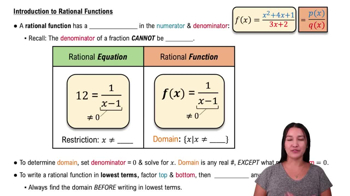
Rational functions are ratios of polynomials, and they can have points of discontinuity where the denominator equals zero. In this case, h(t) has a denominator of (t - 2), which becomes zero at t = 2, indicating a potential discontinuity. To extend h(t) to be continuous at t = 2, we need to simplify the function and find a suitable value for h(2) that resolves this discontinuity.
Recommended video:
6:04
Intro to Rational Functions
Related Practice
Textbook Question

Using Limit Rules


Suppose lim x→0 f(x) = 1 and lim x→0 g(x) = −5. Name the rules in Theorem 1 that are used to accomplish steps (a), (b), and (c) of the following calculation.


limx→0 (2f(x) − g(x)) / (f(x) + 7)² = limx→0 (2f(x) − g(x)) / limx→0 (f(x) + 7)² (a)


(We assume the denominator is nonzero.)


(lim x→0 2f(x) − lim x→0 g(x)) / (lim x→0 (f(x) + 7))² (b)


= (2 lim x→0 f(x) − lim x→0 g(x)) / (lim x→0 f(x) + lim x→0 7)² (c)


= ((2)(1) − (−5)) / (1 + 7)² = 7/64

207
views
Textbook Question

For what values of a and b is

g(x) = { ax + 2b, x ≤ 0

x² + 3a – b, 0 < x ≤ 2

3x – 5, x > 2

continuous at every x?

257
views
Textbook Question

Limits as x → ∞ or x → −∞


The process by which we determine limits of rational functions applies equally well to ratios containing noninteger or negative powers of x. Divide numerator and denominator by the highest power of x in the denominator and proceed from there. Find the limits in Exercises 23–36. Write ∞ or −∞ where appropriate.


lim x → ⁻∞ ((1 − x³) / (x² + 7x))⁵

315
views
Textbook Question

Using the Formal Definition


Prove the limit statements in Exercises 37–50.


limx→9 √(x − 5) = 2

317
views
Textbook Question

Use formal definitions to prove the limit statements in Exercises 93–96.


lim x → 3 (−2 / (x − 3)²) = −∞

266
views
Textbook Question

The sign-preserving property of continuous functions Let f be defined on an interval (a, b) and suppose that f(c) ≠ 0 at some c where f is continuous. Show that there is an interval (c − δ, c + δ) about c where f has the same sign as f(c).

409
views