
Textbook Question
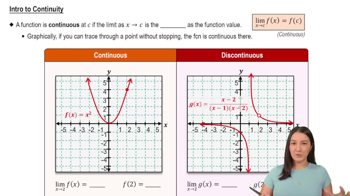
Define h(2) in a way that extends h(t) = (t² + 3t − 10)/(t − 2) to be continuous at t = 2.
241
views

 Verified step by step guidance
 05:34
05:34
 4:46
4:46 05:43
05:43Define h(2) in a way that extends h(t) = (t² + 3t − 10)/(t − 2) to be continuous at t = 2.
Using Limit Rules
Suppose lim x→0 f(x) = 1 and lim x→0 g(x) = −5. Name the rules in Theorem 1 that are used to accomplish steps (a), (b), and (c) of the following calculation.
limx→0 (2f(x) − g(x)) / (f(x) + 7)² = limx→0 (2f(x) − g(x)) / limx→0 (f(x) + 7)² (a)
(We assume the denominator is nonzero.)
(lim x→0 2f(x) − lim x→0 g(x)) / (lim x→0 (f(x) + 7))² (b)
= (2 lim x→0 f(x) − lim x→0 g(x)) / (lim x→0 f(x) + lim x→0 7)² (c)
= ((2)(1) − (−5)) / (1 + 7)² = 7/64
Use formal definitions to prove the limit statements in Exercises 93–96.
lim x → 3 (−2 / (x − 3)²) = −∞
Suppose that f(x) and g(x) are polynomials in x. Can the graph of f(x)/g(x) have an asymptote if g(x) is never zero? Give reasons for your answer.
Limits as x → ∞ or x → −∞
The process by which we determine limits of rational functions applies equally well to ratios containing noninteger or negative powers of x. Divide numerator and denominator by the highest power of x in the denominator and proceed from there. Find the limits in Exercises 23–36. Write ∞ or −∞ where appropriate.
lim x → ∞ √((8x² − 3) / (2x² + x))
Never-zero continuous functions Is it true that a continuous function that is never zero on an interval never changes sign on that interval? Give reasons for your answer.