
Motion Along a Coordinate Line
Exercises 1–6 give the positions s = f(t) of a body moving on a coordinate line, with s in meters and t in seconds.
b. Find the body’s speed and acceleration at the endpoints of the interval.
s = 25/t² − 5/t, 1 ≤ t ≤ 5
Verified step by step guidance
Motion Along a Coordinate Line
Exercises 1–6 give the positions s = f(t) of a body moving on a coordinate line, with s in meters and t in seconds.
b. Find the body’s speed and acceleration at the endpoints of the interval.
s = 25/t² − 5/t, 1 ≤ t ≤ 5
Quadratic approximations
b. Find the quadratic approximation to f(x) = 1/(1 − x) at x = 0.
Suppose that the functions f and g and their derivatives with respect to x have the following values at x = 0 and x = 1.
" style="" width="250">
Find the derivatives with respect to x of the following combinations at the given value of x.
b. f(x)g³(x), x = 0
The folium of Descartes (See Figure 3.27)
b. At what point other than the origin does the folium have a horizontal tangent line?
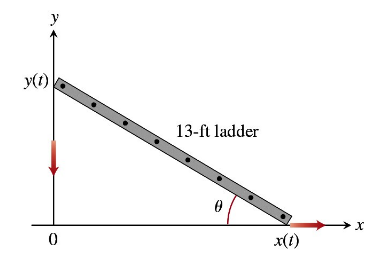
Hauling in a dinghy A dinghy is pulled toward a dock by a rope from the bow through a ring on the dock 6 ft above the bow. The rope is hauled in at the rate of 2 ft/sec.
b. At what rate is the angle θ changing at this instant (see the figure)?
By computing the first few derivatives and looking for a pattern, find the following derivatives.
b. d¹¹⁰/dx¹¹⁰ (sin x − 3 cos x)