
Ch. 3 - Derivatives
Hass - Thomas' Calculus 15th Edition
Hass15th EditionThomas' CalculusISBN: 9780137616077Not the one you use?Change textbook
Chapter 3, Problem 3.8.32b

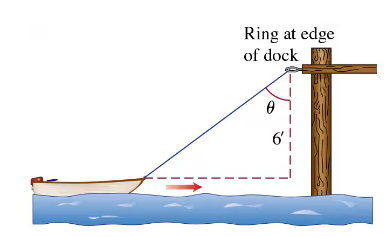
Hauling in a dinghy A dinghy is pulled toward a dock by a rope from the bow through a ring on the dock 6 ft above the bow. The rope is hauled in at the rate of 2 ft/sec.


b. At what rate is the angle θ changing at this instant (see the figure)?
A dinghy being pulled toward a dock by a rope, with a ring on the dock 6 ft above the bow, illustrating related rates.

Verified step by step guidance
1
First, identify the relationship between the variables involved. We have a right triangle where the vertical side is 6 ft (the height of the ring above the bow), the hypotenuse is the length of the rope, and the angle θ is formed between the rope and the horizontal line from the bow to the dock.
Use trigonometric relationships to express the angle θ in terms of the length of the rope. Specifically, use the sine function: sin(θ) = opposite/hypotenuse = 6/L, where L is the length of the rope.
Differentiate the equation sin(θ) = 6/L with respect to time t to find the rate of change of the angle θ. This involves implicit differentiation. Remember that dL/dt is given as -2 ft/sec (since the rope is being pulled in, the length is decreasing).
Apply the chain rule to differentiate: d(sin(θ))/dt = cos(θ) * dθ/dt and d(6/L)/dt = -6/L^2 * dL/dt. Set these two derivatives equal to each other: cos(θ) * dθ/dt = -6/L^2 * (-2).
Solve for dθ/dt, the rate at which the angle θ is changing. Substitute the known values into the equation, including the current length of the rope if needed, to find the expression for dθ/dt.

Verified video answer for a similar problem:

This video solution was recommended by our tutors as helpful for the problem above.
Video duration:
7m
Was this helpful?

Key Concepts

Here are the essential concepts you must grasp in order to answer the question correctly.

Related Rates

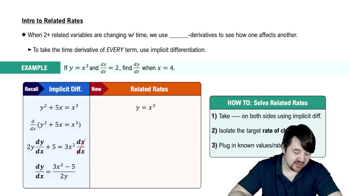
Related rates involve finding the rate at which one quantity changes with respect to another. In this problem, the rate at which the rope is hauled in affects the rate at which the angle θ changes. By using derivatives, we can relate these rates and solve for the unknown rate of change of θ.
Recommended video:
04:16
Intro To Related Rates

Trigonometric Relationships

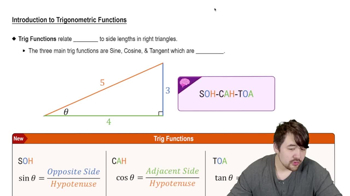
Trigonometric relationships are essential for understanding how the angle θ changes as the rope is pulled. The problem involves a right triangle formed by the rope, the vertical distance from the dock to the bow, and the horizontal distance from the dock to the dinghy. Using trigonometric functions like sine or cosine can help express θ in terms of these distances.
Recommended video:
6:04
Introduction to Trigonometric Functions

Implicit Differentiation

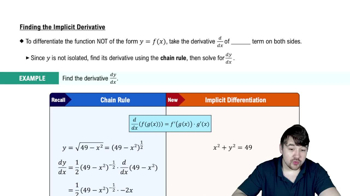
Implicit differentiation is used when dealing with equations involving multiple variables that are not easily separated. In this scenario, the relationship between the angle θ, the length of the rope, and the distances involved can be differentiated implicitly to find the rate of change of θ with respect to time, given the rate at which the rope is pulled.
Recommended video:
05:14
Finding The Implicit Derivative