

Ch. 3 - Derivatives
Hass - Thomas' Calculus 15th Edition
Hass15th EditionThomas' CalculusISBN: 9780137616077Not the one you use?Change textbook
Chapter 3, Problem 3.8.18c

Diagonals If x, y, and z are lengths of the edges of a rectangular box, then the common length of the box’s diagonals is s = √(x² + y² + z²).
c. How are dx/dt, dy/dt, and dz/dt related if s is constant?

Verified step by step guidance
1
Start by understanding the given formula for the diagonal length of a rectangular box: \( s = \sqrt{x^2 + y^2 + z^2} \). This represents the length of the diagonal in terms of the edge lengths x, y, and z.
Since s is constant, differentiate both sides of the equation with respect to time t. This involves using implicit differentiation because x, y, and z are functions of time.
The differentiation of the left side, since s is constant, is \( \frac{ds}{dt} = 0 \).
For the right side, apply the chain rule: \( \frac{d}{dt}(x^2 + y^2 + z^2) = 2x \frac{dx}{dt} + 2y \frac{dy}{dt} + 2z \frac{dz}{dt} \).
Set the derivative of the right side equal to zero (from step 3): \( 2x \frac{dx}{dt} + 2y \frac{dy}{dt} + 2z \frac{dz}{dt} = 0 \). Simplify this equation to find the relationship between \( \frac{dx}{dt}, \frac{dy}{dt}, \) and \( \frac{dz}{dt} \).

Verified video answer for a similar problem:

This video solution was recommended by our tutors as helpful for the problem above.
Video duration:
3m
Was this helpful?

Key Concepts

Here are the essential concepts you must grasp in order to answer the question correctly.

Partial Derivatives

Partial derivatives involve differentiating a function with respect to one variable while keeping other variables constant. In the context of the problem, understanding how each edge length x, y, and z changes over time (dx/dt, dy/dt, dz/dt) requires applying partial derivatives to the formula for the diagonal length s.
Recommended video:
05:44
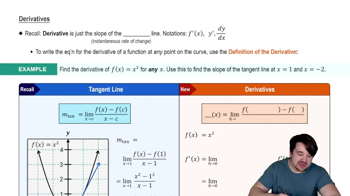
Derivatives

Chain Rule

The chain rule is a fundamental concept in calculus used to differentiate composite functions. It is essential for relating the rates of change of x, y, and z to the rate of change of s. Since s is constant, the chain rule helps establish a relationship between dx/dt, dy/dt, and dz/dt by differentiating the equation s = √(x² + y² + z²) with respect to time.
Recommended video:
05:02
Intro to the Chain Rule

Implicit Differentiation

Implicit differentiation is used when a function is not explicitly solved for one variable. In this problem, since s is constant, implicit differentiation allows us to differentiate the equation s = √(x² + y² + z²) with respect to time, treating s as a constant and finding how dx/dt, dy/dt, and dz/dt are interrelated.
Recommended video:
05:14
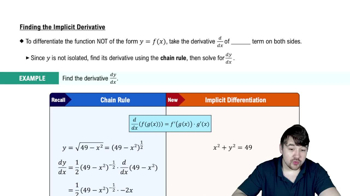
Finding The Implicit Derivative
Related Practice
Textbook Question

Motion Along a Coordinate Line


Exercises 1–6 give the positions s = f(t) of a body moving on a coordinate line, with s in meters and t in seconds.


c. When, if ever, during the interval does the body change direction?


s = 25/(t + 5), −4 ≤ t ≤ 0

209
views
Textbook Question

Analyzing Motion Using Graphs


[Technology Exercise] Exercises 31–34 give the position function s = f(t) of an object moving along the s-axis as a function of time t. Graph f together with the velocity function v(t) = ds/dt = f'(t) and the acceleration function a(t) = d²s/dt² = f''(t). Comment on the object’s behavior in relation to the signs and values of v and a. Include in your commentary such topics as the following:


c. When does it change direction?


s = t² - 3t + 2, 0 ≤ t ≤ 5

177
views
Textbook Question

Theory and Examples


In Exercises 51–54,


c. For what values of x, if any, is f' positive? Zero? Negative?


y = −x²

157
views
Textbook Question

Suppose that the functions f and g and their derivatives with respect to x have the following values at x = 0 and x = 1.


" style="max-width: 100%; white-space-collapse: preserve;" width="250">


Find the derivatives with respect to x of the following combinations at the given value of x.


c. f(x) / (g(x) + 1), x = 1

235
views
Textbook Question

Right circular cylinder The total surface area S of a right circular cylinder is related to the base radius r and height h by the equation S = 2πr² + 2πrh.


c. How is dS/dt related to dr/dt and dh/dt if neither r nor h is constant?

934
views
Textbook Question

Differentiability and Continuity on an Interval


Each figure in Exercises 45–50 shows the graph of a function over a closed interval D. At what domain points does the function appear to be


c. neither continuous nor differentiable?


Give reasons for your answers.


257
views