
Ch. 3 - Derivatives
Hass - Thomas' Calculus 15th Edition
Hass15th EditionThomas' CalculusISBN: 9780137616077Not the one you use?Change textbook
Chapter 3, Problem 3.95c

Right circular cylinder The total surface area S of a right circular cylinder is related to the base radius r and height h by the equation S = 2πr² + 2πrh.


c. How is dS/dt related to dr/dt and dh/dt if neither r nor h is constant?

Verified step by step guidance
1
Start by identifying the given equation for the total surface area of the cylinder: \( S = 2\pi r^2 + 2\pi rh \).
Recognize that \( S \), \( r \), and \( h \) are all functions of time \( t \), so we need to use implicit differentiation with respect to \( t \).
Differentiate both sides of the equation with respect to \( t \). For the first term \( 2\pi r^2 \), use the chain rule: \( \frac{d}{dt}(2\pi r^2) = 4\pi r \frac{dr}{dt} \).
For the second term \( 2\pi rh \), apply the product rule: \( \frac{d}{dt}(2\pi rh) = 2\pi \left( r \frac{dh}{dt} + h \frac{dr}{dt} \right) \).
Combine the differentiated terms to express \( \frac{dS}{dt} \) in terms of \( \frac{dr}{dt} \) and \( \frac{dh}{dt} \): \( \frac{dS}{dt} = 4\pi r \frac{dr}{dt} + 2\pi \left( r \frac{dh}{dt} + h \frac{dr}{dt} \right) \).

Verified video answer for a similar problem:

This video solution was recommended by our tutors as helpful for the problem above.
Video duration:
2m
Was this helpful?

Key Concepts

Here are the essential concepts you must grasp in order to answer the question correctly.

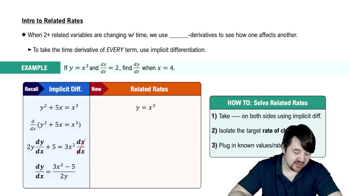
Related Rates

Related rates involve finding the rate at which one quantity changes in relation to another. In this context, we are interested in how the surface area of a cylinder changes with respect to time as both the radius and height change. This concept is fundamental in calculus, as it allows us to connect different rates of change through derivatives.
Recommended video:
04:16
Intro To Related Rates

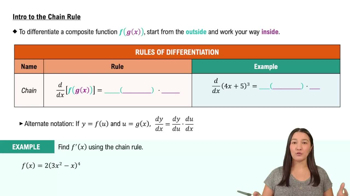
Chain Rule

The chain rule is a fundamental principle in calculus used to differentiate composite functions. In the context of the given problem, it allows us to express the derivative of the surface area with respect to time as a function of the derivatives of the radius and height. This is crucial for relating the rates of change of different variables.
Recommended video:
05:02
Intro to the Chain Rule

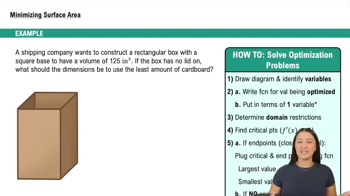
Surface Area of a Cylinder

The surface area of a right circular cylinder is given by the formula S = 2πr² + 2πrh, which includes contributions from both the circular bases and the lateral surface. Understanding this formula is essential for applying related rates, as it provides the relationship between the radius, height, and surface area that we need to differentiate with respect to time.
Recommended video:
09:07
Example 1: Minimizing Surface Area
Related Practice
Textbook Question

Motion Along a Coordinate Line


Exercises 1–6 give the positions s = f(t) of a body moving on a coordinate line, with s in meters and t in seconds.


c. When, if ever, during the interval does the body change direction?


s = 25/(t + 5), −4 ≤ t ≤ 0

209
views
Textbook Question

Analyzing Motion Using Graphs


[Technology Exercise] Exercises 31–34 give the position function s = f(t) of an object moving along the s-axis as a function of time t. Graph f together with the velocity function v(t) = ds/dt = f'(t) and the acceleration function a(t) = d²s/dt² = f''(t). Comment on the object’s behavior in relation to the signs and values of v and a. Include in your commentary such topics as the following:


c. When does it change direction?


s = t² - 3t + 2, 0 ≤ t ≤ 5

177
views
Textbook Question

Theory and Examples


In Exercises 51–54,


c. For what values of x, if any, is f' positive? Zero? Negative?


y = −x²

157
views
Textbook Question

Suppose that the functions f and g and their derivatives with respect to x have the following values at x = 0 and x = 1.


" style="max-width: 100%; white-space-collapse: preserve;" width="250">


Find the derivatives with respect to x of the following combinations at the given value of x.


c. f(x) / (g(x) + 1), x = 1

235
views
Textbook Question

Differentiability and Continuity on an Interval


Each figure in Exercises 45–50 shows the graph of a function over a closed interval D. At what domain points does the function appear to be


c. neither continuous nor differentiable?


Give reasons for your answers.


193
views
Textbook Question

Diagonals If x, y, and z are lengths of the edges of a rectangular box, then the common length of the box’s diagonals is s = √(x² + y² + z²).

c. How are dx/dt, dy/dt, and dz/dt related if s is constant?

194
views