
Ch. 3 - Derivatives
Hass - Thomas' Calculus 15th Edition
Hass15th EditionThomas' CalculusISBN: 9780137616077Not the one you use?Change textbook
Chapter 3, Problem 3.5.47b

In Exercises 47 and 48, find an equation for


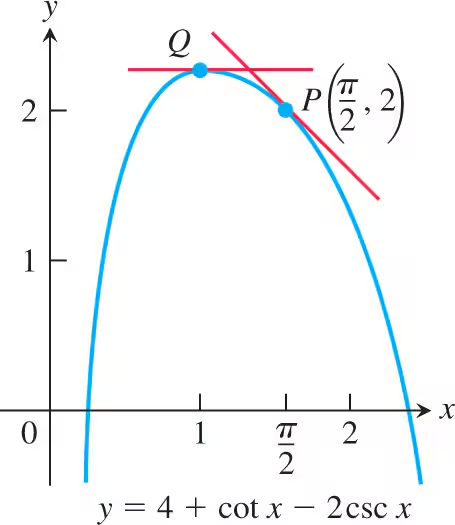
(b) the horizontal tangent line to the curve at Q.


<IMAGE>

Verified step by step guidance
1
Step 1: Identify the given curve equation, which is y = 4 + cot(x) - 2csc(x). The goal is to find the horizontal tangent line at point Q. A horizontal tangent occurs when the derivative of the curve, dy/dx, equals zero.
Step 2: Compute the derivative of the curve y = 4 + cot(x) - 2csc(x) with respect to x. Use the derivatives of trigonometric functions: d(cot(x))/dx = -csc^2(x) and d(csc(x))/dx = -csc(x)cot(x).
Step 3: Substitute the derivatives into dy/dx. The derivative becomes dy/dx = -csc^2(x) + 2csc(x)cot(x). Simplify this expression to make it easier to analyze.
Step 4: Set dy/dx = 0 to find the x-coordinate where the tangent is horizontal. Solve the equation -csc^2(x) + 2csc(x)cot(x) = 0 for x. This involves factoring or using trigonometric identities.
Step 5: Once the x-coordinate is found, substitute it back into the original curve equation y = 4 + cot(x) - 2csc(x) to find the corresponding y-coordinate. The equation of the horizontal tangent line will be y = [value of y at Q].

Verified video answer for a similar problem:

This video solution was recommended by our tutors as helpful for the problem above.
Video duration:
5m
Was this helpful?

Key Concepts

Here are the essential concepts you must grasp in order to answer the question correctly.

Horizontal Tangent Line

A horizontal tangent line to a curve at a point indicates that the slope of the tangent at that point is zero. This occurs when the derivative of the function at that point equals zero. Finding a horizontal tangent involves solving for when the derivative of the function is zero, which helps identify points where the curve has a local maximum or minimum.
Recommended video:
05:13
Slopes of Tangent Lines

Derivative of Trigonometric Functions

The derivative of a function provides the slope of the tangent line at any point on the curve. For trigonometric functions like cotangent and cosecant, the derivatives are -csc^2(x) and -csc(x)cot(x), respectively. Understanding these derivatives is crucial for finding where the slope of the tangent line is zero, which is necessary for identifying horizontal tangents.
Recommended video:
6:04
Introduction to Trigonometric Functions

Critical Points

Critical points of a function occur where its derivative is zero or undefined. These points are potential locations for local maxima, minima, or points of inflection. In the context of finding horizontal tangents, critical points are where the derivative equals zero, indicating a potential horizontal tangent line at those points.
Recommended video:
04:50
Critical Points
Related Practice
Textbook Question

Temperatures in Fairbanks, Alaska The graph in the accompanying figure shows the average Fahrenheit temperature in Fairbanks, Alaska, during a typical 365-day year. The equation that approximates the temperature on day x is


y = 37 sin[(2π/365)(x − 101)] + 25


and is graphed in the accompanying figure.


a. On what day is the temperature increasing the fastest?


" style="" width="420">

273
views
Textbook Question

Consider the function f graphed here. The domain of f is the interval [−4, 6] and its graph is made of line segments joined end to end.


" style="" width="350">


b. Graph the derivative of f. The graph should show a step function.

227
views
Textbook Question

Suppose that the functions f and g and their derivatives with respect to x have the following values at x = 0 and x = 1.


" style="" width="250">


Find the derivatives with respect to x of the following combinations at the given value of x.


b. f(x)g³(x), x = 0

279
views
Textbook Question

Fruit flies (Continuation of Example 4, Section 2.1.) Populations starting out in closed environments grow slowly at first, when there are relatively few members, then more rapidly as the number of reproducing individuals increases and resources are still abundant, then slowly again as the population reaches the carrying capacity of the environment.


b. During what days does the population seem to be increasing fastest? Slowest?


240
views
Textbook Question

The folium of Descartes (See Figure 3.27)


b. At what point other than the origin does the folium have a horizontal tangent line?


242
views
Textbook Question

Hauling in a dinghy A dinghy is pulled toward a dock by a rope from the bow through a ring on the dock 6 ft above the bow. The rope is hauled in at the rate of 2 ft/sec.


b. At what rate is the angle θ changing at this instant (see the figure)?

248
views