

Finding Indefinite Integrals
In Exercises 17–56, find the most general antiderivative or indefinite integral. You may need to try a solution and then adjust your guess. Check your answers by differentiation.
∫(1/x² − x² − 1/3) dx
Verified step by step guidance
Finding Indefinite Integrals
In Exercises 17–56, find the most general antiderivative or indefinite integral. You may need to try a solution and then adjust your guess. Check your answers by differentiation.
∫(1/x² − x² − 1/3) dx
Finding Critical Points
In Exercises 41–50, determine all critical points and all domain endpoints for each function.
f(x) = x(4 − x)³
110. Suppose the derivative of the function y = f(x) is
y'=(x-1)^22(x-2)(x-4).
At what points, if any, does the graph of f have a local minimum, local maximum, or
point of inflection?
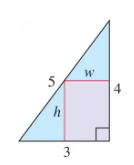
22. A window is in the form of a rectangle surmounted by a semicircle. The rectangle is of clear glass, whereas the semicircle is of tinted glass that transmits only half as much light per unit area as clear glass does. The total perimeter is fixed. Find the proportions of the window that will admit the most light. Neglect the thickness of the frame.
" style="" width="180">
Checking the Mean Value Theorem
Which of the functions in Exercises 7–12 satisfy the hypotheses of the Mean Value Theorem on the given interval, and which do not? Give reasons for your answers.
f(x) = x⁴ᐟ⁵, [0, 1]
Find values of a and b such that the function
ƒ(𝓍) = (a𝓍 + b) / 𝓍² ―1)
has a local extreme value of 1 at 𝓍 = 3. Is this extreme value a local maximum or a local minimum? Give reasons for your answer.