
Textbook Question
35. Determine the dimensions of the rectangle of largest area that can be inscribed in the right triangle shown in the accompanying figure.
377
views

 Verified step by step guidance
 04:50
04:50
 06:02 04:50
35. Determine the dimensions of the rectangle of largest area that can be inscribed in the right triangle shown in the accompanying figure.
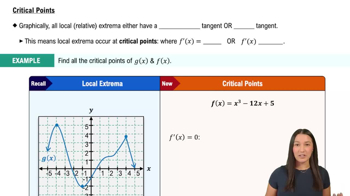
Finding Critical Points
In Exercises 41–50, determine all critical points and all domain endpoints for each function.
f(x) = x(4 − x)³
In Exercises 9–66, graph the function using appropriate methods from the graphing procedures presented just before Example 9, identifying the coordinates of any local extreme points and inflection points. Then find coordinates of absolute extreme points, if any.
y = 1 / (x² - 1)
Finding Functions from Derivatives
In Exercises 37–40, find the function with the given derivative whose graph passes through the point P.
f'(x) = 2x − 1, P(0,0)
Identify the inflection points and local maxima and minima of the functions graphed in Exercises 1–8. Identify the open intervals on which the functions are differentiable and the graphs are concave up and concave down.
7. y=sin|x|, -2π≤x≤2π
22. A window is in the form of a rectangle surmounted by a semicircle. The rectangle is of clear glass, whereas the semicircle is of tinted glass that transmits only half as much light per unit area as clear glass does. The total perimeter is fixed. Find the proportions of the window that will admit the most light. Neglect the thickness of the frame.
" style="" width="180">