Back
Back
Problem 7.8.1.a
1. Which of the following functions grow faster than e^x as x→∞? Which grow at the same rate as e^x? Which grow slower?
a. x-3
Problem 7.1.44a
In Exercises 41–44:
a. Find f⁻¹(x).
44. f(x) = 2x², x ≥ 0, a = 5
Problem 7.4.1a
In Exercises 1–4, show that each function y=f(x) is a solution of the accompanying differential equation.
1. 2y' + 3y = e^(-x)
a. y = e^(-x)
Problem 7.1.37a
Find the inverse of the function f(x)=mx, where m is a constant different from zero.
Problem 7.8.9.a
9. True, or false? As x→∞,
a. x = o(x)
Problem 7.6.5a
Use reference triangles in an appropriate quadrant to find the angles in Exercises 1–8.
5. a. arccos(1/2)
Problem 7.2.84a
84.a. Find the center of mass of a thin plate of constant density covering the region between the curve y=1/√x and the x-axis from x=1 to x=16.
Problem 7.8.2.a
2. Which of the following functions grow faster than e^x as x→∞? Which grow at the same rate as e^x? Which grow slower?
a. 10x^4 + 30x + 1
Problem 7.1.40a
Find the inverse of f(x)=-x+1. Graph the line y=-x+1 together with the line y=x. At what angle do the lines intersect?
Problem 7.7.69a
Evaluate the integrals in Exercises 67–74 in terms of
a. inverse hyperbolic functions.
69. ∫(from 5/4 to 2)dx/(1-x²)
Problem 7.5.80b
80. Find all values of c that satisfy the conclusion of Cauchy's Mean Value Theorem for the given functions and interval.
b. f(x) = x, g(x) = x², (a, b) arbitrary
Problem 7.1.39b
Find the inverse of f(x)=x+b (b constant). How is the graph of f^(-1) related to the graph of f?
Problem 7.1.67b
In Exercises 67–72, you will explore some functions and their inverses together with their derivatives and tangent line approximations at specified points. Perform the following steps using your CAS:
b. Solve the equation y=f(x) for x as a function of y, and name the resulting inverse function g.
67. y= √(3x-2), 2/3 ≤ x ≤ 4, x_0=3
Problem 7.6.4b
Use reference triangles in an appropriate quadrant to find the angles in Exercises 1–8.
4. b. arcsin(-1/√2)
Problem 7.7.73b
Evaluate the integrals in Exercises 67–74 in terms of
b. natural logarithms.
73. ∫(from 0 to π)cos(x)dx/√(1+sin²x)
Problem 7.6.8b
Use reference triangles in an appropriate quadrant to find the angles in Exercises 1–8.
8. b. arccot(√3)
Problem 7.6.2b
Use reference triangles in an appropriate quadrant to find the angles in Exercises 1–8.
2. b. tan^(-1)(√3)
Problem 7.2.1b
1. Express the following logarithms in terms of ln 2 and ln 3.
b. ln(4/9)
Problem 7.7.69b
Evaluate the integrals in Exercises 67–74 in terms of
b. natural logarithms.
69. ∫(from 5/4 to 2)dx/(1-x²)
Problem 7.3.132b
132. Let f(x) = e^x / (1 + e^(2x)).
b. Find all inflection points for f.
Problem 7.5.91.b
91. [Technology Exercise] 91. The continuous extension of to (sin x)^x to [0, π]
b. Verify your conclusion in part (a) by finding lim(x→0⁺)f(x) with l’Hôpital’s Rule.
Problem 7.1.72b
In Exercises 67–72, you will explore some functions and their inverses together with their derivatives and tangent line approximations at specified points. Perform the following steps using your CAS:
b. Solve the equation y=f(x) for x as a function of y, and name the resulting inverse function g.
72. y= 2-x-x³, -2 ≤ x ≤ 2, x_0 = 3/2
Problem 7.7.67b
Evaluate the integrals in Exercises 67–74 in terms of
b. natural logarithms.
67. ∫(from 0 to 2√3)dx/√(4+x²)
Problem 7.1.47b
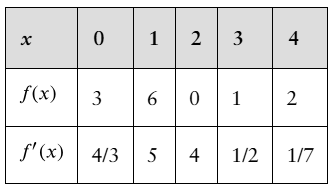
Suppose that the function f and its derivative with respect to x have the following values at x=0, 1, 2, 3, and 4.
Assuming the inverse function f^(-1) is differentiable, find the slope of f^(-1)(x) at
b. x=2
Problem 7.1.70b
In Exercises 67–72, you will explore some functions and their inverses together with their derivatives and tangent line approximations at specified points. Perform the following steps using your CAS:
b. Solve the equation y=f(x) for x as a function of y, and name the resulting inverse function g.
70. y= x³/(x²+1), -1 ≤ x ≤ 1, x_0=1/2
Problem 7.7.37b
Verify the integration formulas in Exercises 37–40.
37. b. ∫sech(x)dx = sin⁻¹(tanh x) + C
Problem 7.2.84b
b. Find the center of mass if, instead of being constant, the density function is δ(x)=4/√x.
Problem 7.2.75b
75. b. Identify the function’s local and absolute extreme values, if any, saying where they occur.
g(x) = x(ln x)²
Problem 7.6.6b
Use reference triangles in an appropriate quadrant to find the angles in Exercises 1–8.
6. b. arccsc(-2/√3)
Problem 7.6.135b
Find the volumes of the solids in Exercises 135 and 136.
135. The solid lies between planes perpendicular to the x-axis at x=-1 and x=1. The cross-sections perpendicular to the x-axis are
b. vertical squares whose base edges run from the curve y=-1/√(1+x²) to the curve y=1/√(1+x²).