In Exercises 23–34, factor out the negative of the greatest common factor.−x² − 7x + 5
Verified step by step guidance
1
Identify the greatest common factor (GCF) of the terms in the expression \(-x^2 - 7x + 5\).
Notice that the leading term \(-x^2\) has a negative sign, so we will factor out a negative GCF.
The GCF of the terms \(-x^2\), \(-7x\), and \(5\) is \(1\), but we factor out \(-1\) to change the signs of all terms.
Rewrite the expression by factoring out \(-1\): \(-1(x^2 + 7x - 5)\).
Verify the factorization by distributing \(-1\) back into the expression to ensure it matches the original expression.
Verified video answer for a similar problem:
This video solution was recommended by our tutors as helpful for the problem above
Video duration:
2m
Play a video:
0 Comments
Key Concepts
Here are the essential concepts you must grasp in order to answer the question correctly.
Greatest Common Factor (GCF)
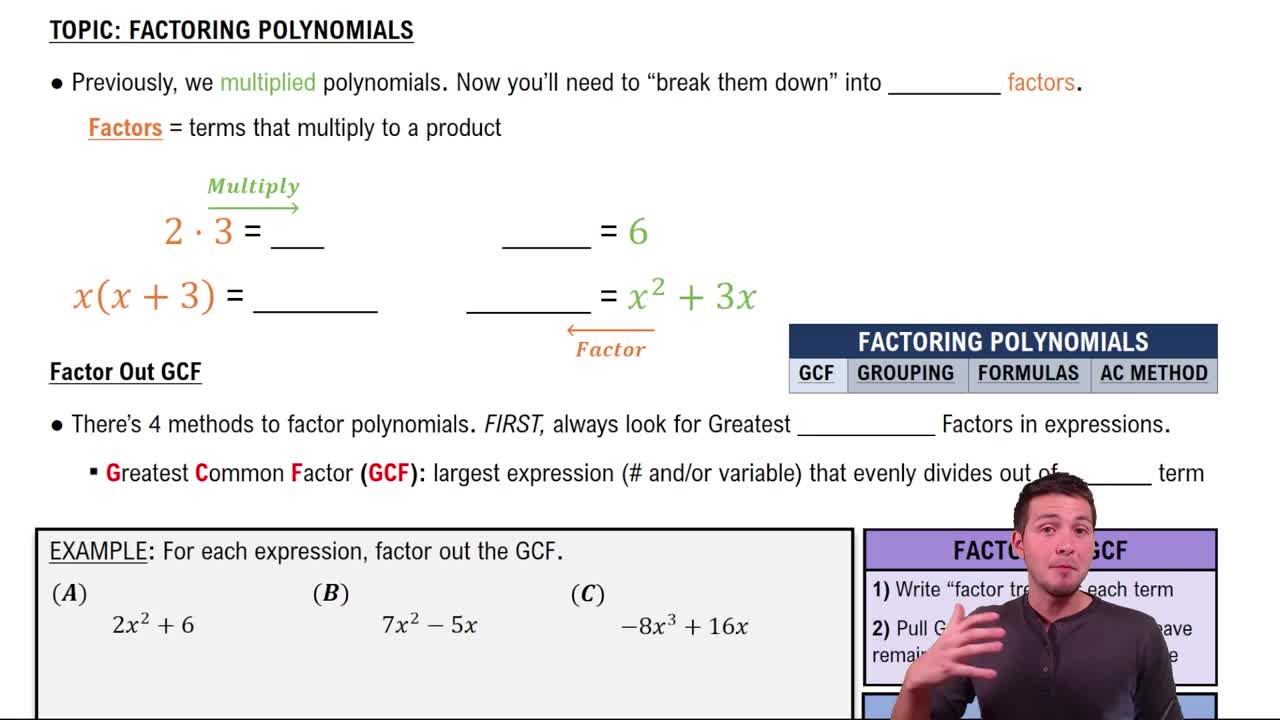
The Greatest Common Factor is the largest integer or algebraic expression that divides all terms in a polynomial without leaving a remainder. To find the GCF, identify the common factors of the coefficients and the variables in each term. In the expression −x² − 7x + 5, the GCF is -1, as it is the largest factor that can be factored out from all terms.
Factoring polynomials involves rewriting a polynomial as a product of simpler polynomials or factors. This process is essential for simplifying expressions, solving equations, and analyzing polynomial behavior. In this case, factoring out the GCF helps to simplify the polynomial and makes it easier to work with in further calculations.
When factoring out a negative sign, it is important to change the signs of all terms in the polynomial. This is because factoring out a negative affects the overall expression, converting positive terms to negative and vice versa. In the given polynomial, factoring out -1 will result in the expression x² + 7x - 5, which is crucial for further manipulation or solving.

 2:02 minutes
 Verified step by step guidance
 5:57
5:57