Factor each polynomial by grouping. See Example 2.
Verified step by step guidance
1
Rewrite the polynomial to group terms that can be factored together: \$4x^{6} + 36 - x^{6}y - 9y\( can be grouped as \)(4x^{6} + 36) - (x^{6}y + 9y)$.
Factor out the greatest common factor (GCF) from each group: from the first group \$4x^{6} + 36\(, factor out \)4\( to get \)4(x^{6} + 9)\(; from the second group \)x^{6}y + 9y\(, factor out \)y\( to get \)y(x^{6} + 9)$.
Rewrite the expression using the factored groups: \$4(x^{6} + 9) - y(x^{6} + 9)$.
Notice that \((x^{6} + 9)\) is a common binomial factor; factor it out: \((x^{6} + 9)(4 - y)\).
The polynomial is now factored by grouping as \((x^{6} + 9)(4 - y)\).
Verified video answer for a similar problem:
This video solution was recommended by our tutors as helpful for the problem above
Video duration:
3m
Play a video:
0 Comments
Key Concepts
Here are the essential concepts you must grasp in order to answer the question correctly.
Polynomial Grouping
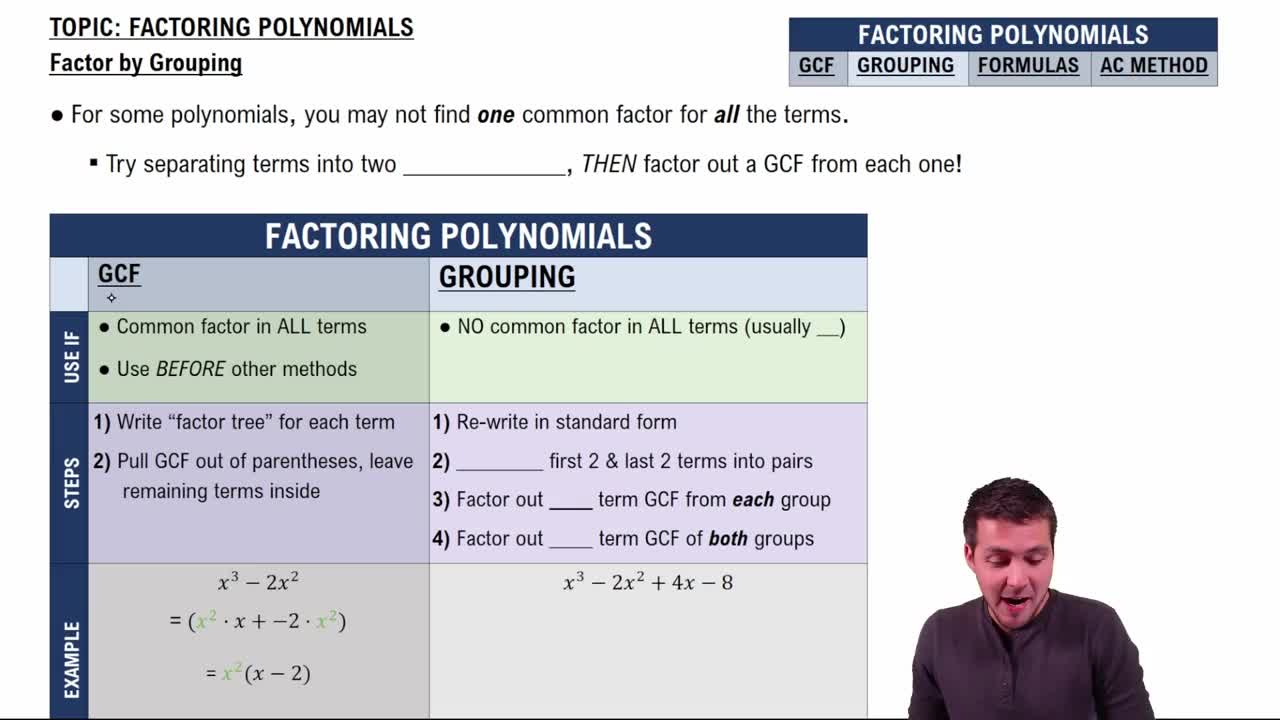
Polynomial grouping involves rearranging and grouping terms in a polynomial to factor each group separately. This method is useful when a polynomial has four or more terms and can be split into pairs or groups that share common factors.
Factoring common factors means identifying and extracting the greatest common factor (GCF) from each group of terms. This simplifies the expression and helps reveal a common binomial factor, which is essential for completing the factorization by grouping.
The difference of squares is a special factoring pattern where an expression of the form a^2 - b^2 factors into (a - b)(a + b). Recognizing this pattern helps factor terms like x^6 - 9y, where powers and constants can be expressed as squares.