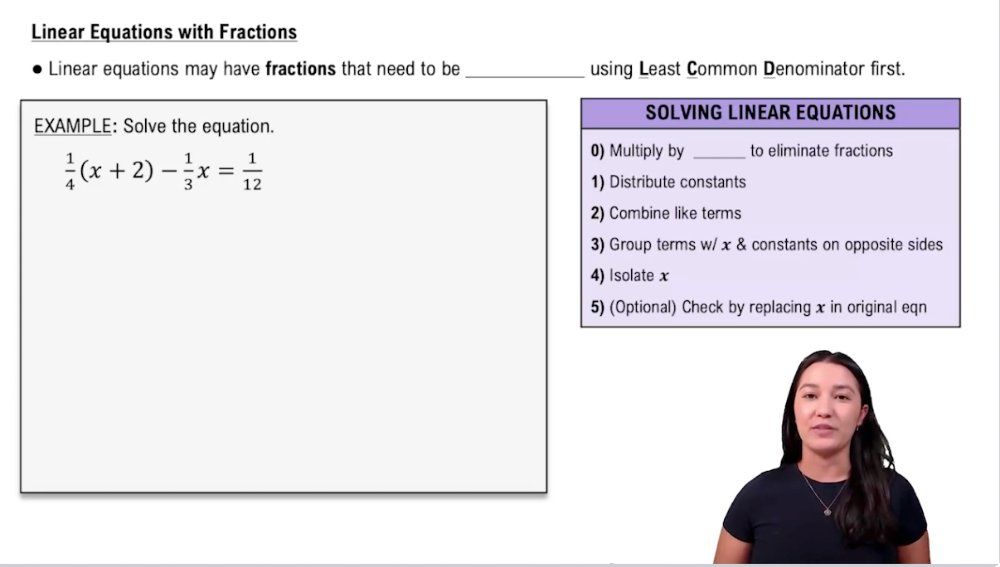
Rewrite the equation to eliminate the fractions by finding the least common denominator (LCD) of all the denominators. The denominators are 5, 2, and 4, so the LCD is 20. Multiply every term in the equation by 20 to clear the fractions.
Distribute the 20 to each term in the equation. For example, multiplying \((x-1)/5\) by 20 gives \(4(x-1)\), multiplying \((x+3)/2\) by 20 gives \(10(x+3)\), and multiplying \(x/4\) by 20 gives \(5x\). Rewrite the equation without fractions.
Simplify the resulting equation by distributing and combining like terms. Expand \(4(x-1)\) and \(10(x+3)\), then simplify both sides of the equation.
Move all terms involving \(x\) to one side of the equation and constants to the other side. Combine like terms to isolate \(x\).
Solve for \(x\) by dividing both sides of the equation by the coefficient of \(x\). Once you have the solution, substitute it back into the original equation to check that it satisfies the equation.
Verified video answer for a similar problem:
This video solution was recommended by our tutors as helpful for the problem above
Video duration:
5m
Play a video:
0 Comments
Key Concepts
Here are the essential concepts you must grasp in order to answer the question correctly.
Rational Expressions
Rational expressions are fractions that contain polynomials in the numerator and denominator. Understanding how to manipulate these expressions, including finding a common denominator, is crucial for solving equations involving them. In the given equation, the terms (x-1)/5 and (x+3)/2 are rational expressions that need to be combined and simplified.
Solving linear equations involves isolating the variable on one side of the equation to find its value. This process often includes combining like terms, using inverse operations, and maintaining equality throughout the manipulation. The equation presented requires applying these techniques to find the value of x that satisfies the equation.
Checking solutions is the process of substituting the found value back into the original equation to verify its correctness. This step ensures that the solution satisfies the equation and helps identify any potential errors made during the solving process. It is an essential practice in algebra to confirm that the derived solution is valid.