
Textbook Question
Use the graph of y = f(x) to graph each function g. g(x) = 2f(x+2) − 1
1289
views

 Verified step by step guidance
 7:24
7:24
 3:51
3:51 06:07
06:07Use the graph of y = f(x) to graph each function g. g(x) = 2f(x+2) − 1
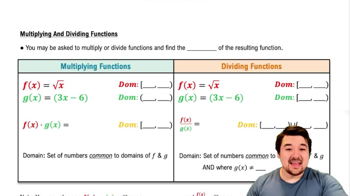
Find fg and determine the domain for each function. f(x) = 2x + 3, g(x) = x − 1
Use the given conditions to write an equation for each line in point-slope form and slope-intercept form. Passing through (−3, 6) and (3, −2)
In Exercises 27–38, evaluate each function at the given values of the independent variable and simplify. h(x) = x4 - x2+1 c. h (-x)
Evaluate each function at the given values of the independent variable and simplify. h(x) = x³ − x + 1 a. h (3)
In Exercises 27–38, evaluate each function at the given values of the independent variable and simplify. h(x) = x4 - x2 +1 d. h (3a)