Find ƒ+g and determine the domain for each function. f(x) = 2x + 3, g(x) = x − 1
Verified step by step guidance
1
Identify the given functions: \(f(x) = 2x + 3\) and \(g(x) = x - 1\).
To find \((f + g)(x)\), add the two functions together: \((f + g)(x) = f(x) + g(x)\).
Substitute the expressions for \(f(x)\) and \(g(x)\) into the sum: \((f + g)(x) = (2x + 3) + (x - 1)\).
Combine like terms to simplify the expression: \((f + g)(x) = 2x + x + 3 - 1\).
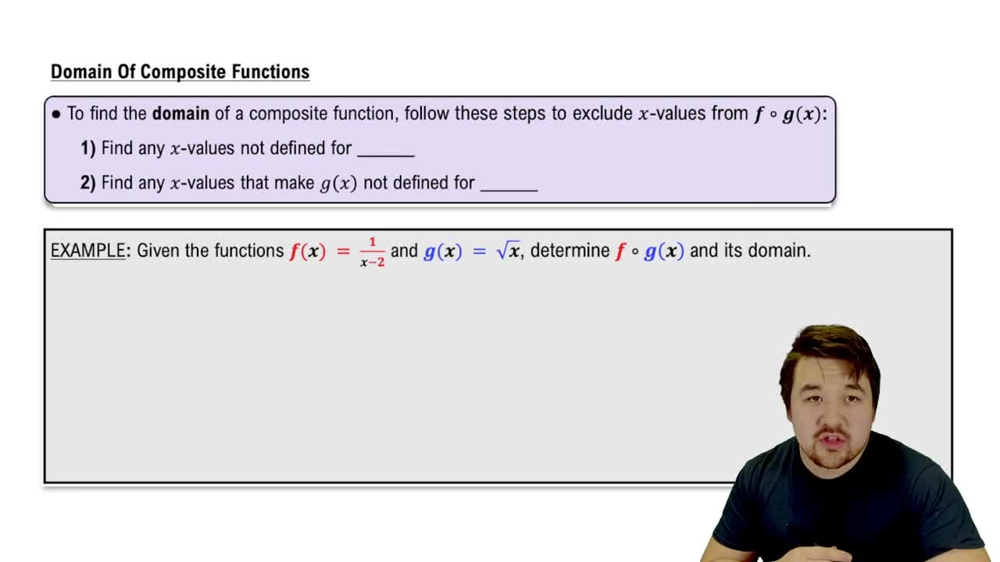
Determine the domain of \((f + g)(x)\) by finding the intersection of the domains of \(f(x)\) and \(g(x)\). Since both are linear functions defined for all real numbers, the domain is all real numbers.
Verified video answer for a similar problem:
This video solution was recommended by our tutors as helpful for the problem above
Video duration:
2m
Play a video:
0 Comments
Key Concepts
Here are the essential concepts you must grasp in order to answer the question correctly.
Function Addition (ƒ + g)
Function addition involves creating a new function by adding the outputs of two given functions for the same input value. For functions f(x) and g(x), (ƒ + g)(x) = f(x) + g(x). This operation combines the expressions algebraically to form a single function.
The domain of a function is the set of all input values (x-values) for which the function is defined. When combining functions, the domain of the resulting function is the intersection of the domains of the original functions, ensuring all inputs are valid for both.
Linear functions are polynomial functions of degree one, typically written as f(x) = mx + b. They have a constant rate of change and their graphs are straight lines. Understanding their form helps in performing operations like addition and determining domains easily.

 2:15 minutes
 Verified step by step guidance
 4:56
4:56