Identify the function given: \(f(x) = \sqrt{5x + 35}\). Since this is a square root function, the expression inside the square root must be greater than or equal to zero for the function to be defined.
Set up the inequality to find the domain: \(5x + 35 \geq 0\).
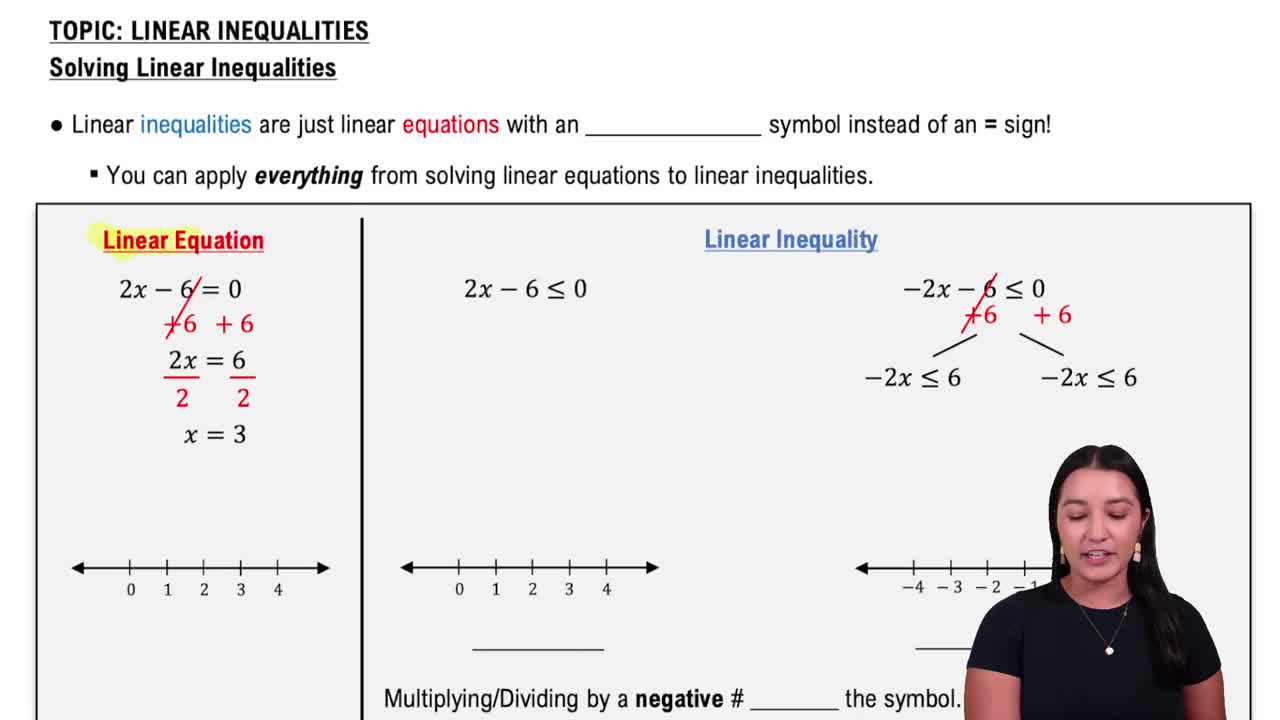
Solve the inequality for \(x\): Subtract 35 from both sides to get \(5x \geq -35\).
Divide both sides of the inequality by 5 (note that dividing by a positive number does not change the inequality direction): \(x \geq -7\).
Write the domain in interval notation: The domain is all real numbers \(x\) such that \(x\) is greater than or equal to \(-7\), which is \([-7, \infty)\).
Verified video answer for a similar problem:
This video solution was recommended by our tutors as helpful for the problem above
Video duration:
2m
Play a video:
0 Comments
Key Concepts
Here are the essential concepts you must grasp in order to answer the question correctly.
Domain of a Function
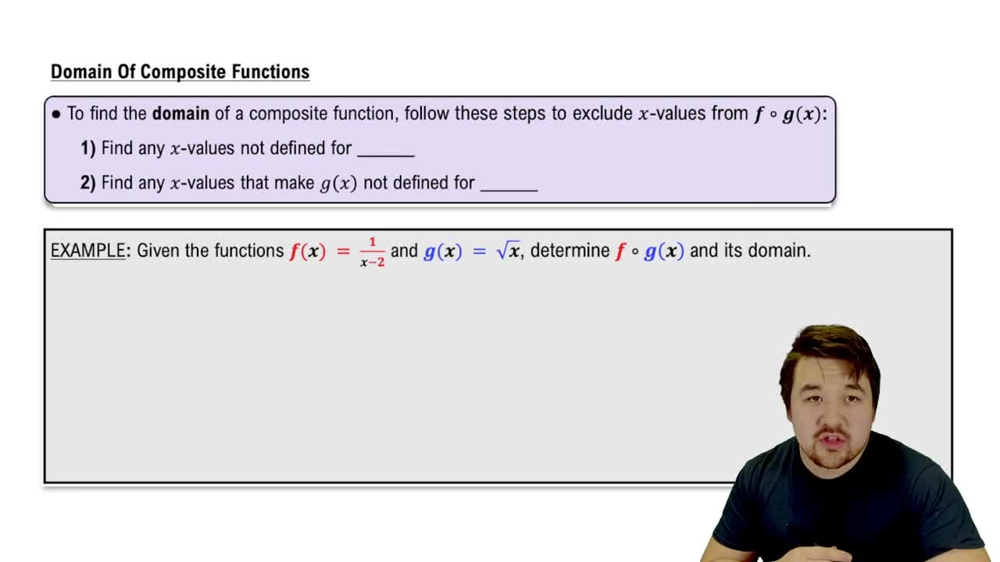
The domain of a function is the set of all possible input values (x-values) for which the function is defined. For real-valued functions, this means identifying all x-values that do not cause undefined expressions such as division by zero or taking the square root of a negative number.
When dealing with square root functions, the expression inside the root (the radicand) must be greater than or equal to zero to produce real number outputs. This restriction ensures the function's output remains within the real number system.
To find the domain involving inequalities, you solve for x by setting the radicand greater than or equal to zero. This involves algebraic manipulation and understanding how to express the solution set, often using interval notation.

 2:12 minutes
 Verified step by step guidance
 3:51
3:51