Use the graph of y = f(x) to graph each function g. g(x) = f(x + 1) − 2
Verified step by step guidance
1
Understand the problem: The given function g(x) = f(x + 1) − 2 is a transformation of the function f(x). The goal is to apply the transformations step by step to the graph of f(x).
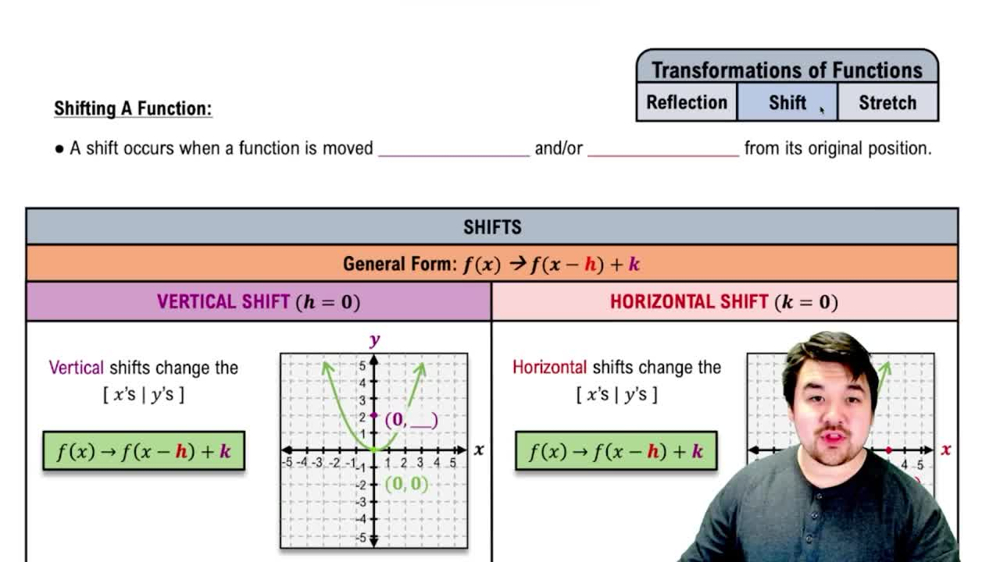
Step 1: Identify the horizontal shift. The term (x + 1) inside the function indicates a horizontal shift. Specifically, it shifts the graph of f(x) 1 unit to the left. This is because adding a positive value inside the parentheses moves the graph in the negative x-direction.
Step 2: Apply the horizontal shift. Take the graph of f(x) and move every point on the graph 1 unit to the left. This gives you an intermediate graph of f(x + 1).
Step 3: Identify the vertical shift. The term −2 outside the function indicates a vertical shift. Specifically, it shifts the graph of f(x + 1) 2 units downward. This is because subtracting a value outside the function moves the graph in the negative y-direction.
Step 4: Apply the vertical shift. Take the intermediate graph of f(x + 1) and move every point on the graph 2 units downward. The resulting graph is the graph of g(x) = f(x + 1) − 2.
Verified video answer for a similar problem:
This video solution was recommended by our tutors as helpful for the problem above
Video duration:
3m
Play a video:
0 Comments
Key Concepts
Here are the essential concepts you must grasp in order to answer the question correctly.
Function Transformation
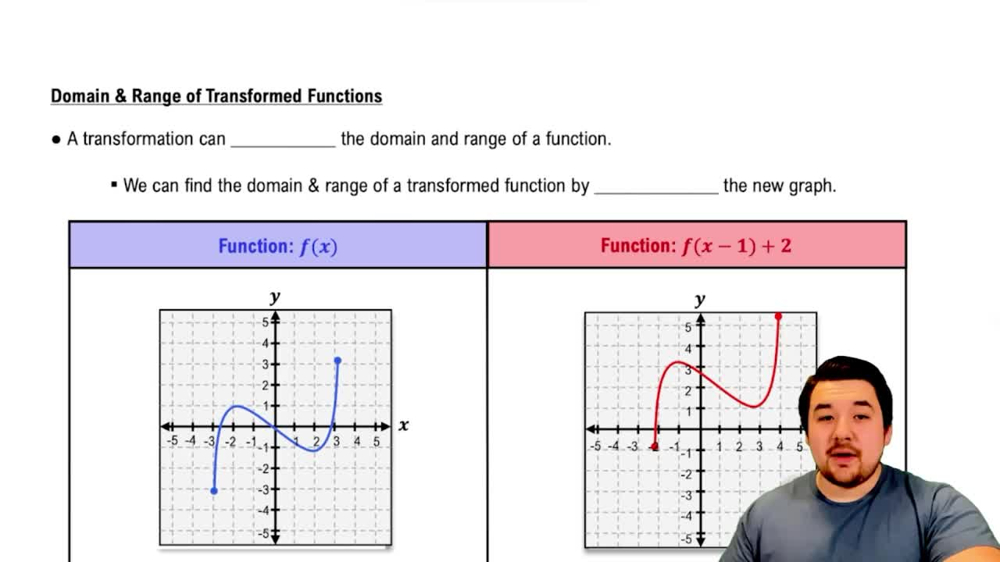
Function transformation refers to the changes made to the graph of a function based on modifications to its equation. In this case, g(x) = f(x + 1) - 2 involves a horizontal shift to the left by 1 unit and a vertical shift downward by 2 units. Understanding these transformations is crucial for accurately graphing the new function based on the original function's graph.
Horizontal shifts occur when the input variable of a function is altered, affecting the graph's position along the x-axis. For g(x) = f(x + 1), the '+1' indicates a shift to the left. This concept is essential for determining how the graph of f(x) will be adjusted to create g(x).
Vertical shifts involve moving the graph of a function up or down along the y-axis. In the function g(x) = f(x + 1) - 2, the '-2' indicates a downward shift of 2 units. Recognizing how vertical shifts affect the overall graph is important for accurately representing the new function derived from f(x).

 3:55 minutes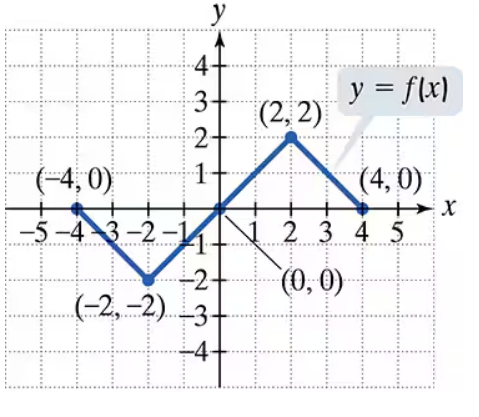
 Verified step by step guidance
 4:22
4:22