Use the graph of y = f(x) to graph each function g. g(x) = f(x) - 1
Verified step by step guidance
1
Step 1: Understand the transformation g(x) = f(x) - 1. This represents a vertical shift of the graph of f(x) downward by 1 unit. Each point on the graph of f(x) will have its y-coordinate decreased by 1.
Step 2: Identify key points on the graph of f(x). The given graph has three notable points: (-3, 0), (3, 0), and (0, -9). These points will be transformed according to the vertical shift.
Step 3: Apply the transformation to each key point. For the point (-3, 0), subtract 1 from the y-coordinate to get (-3, -1). For the point (3, 0), subtract 1 from the y-coordinate to get (3, -1). For the point (0, -9), subtract 1 from the y-coordinate to get (0, -10).
Step 4: Plot the transformed points on the graph. The new points are (-3, -1), (3, -1), and (0, -10). These points represent the graph of g(x).
Step 5: Draw the graph of g(x) by connecting the transformed points smoothly, maintaining the same shape as the original graph of f(x), but shifted downward by 1 unit.
Verified video answer for a similar problem:
This video solution was recommended by our tutors as helpful for the problem above
Video duration:
1m
Play a video:
0 Comments
Key Concepts
Here are the essential concepts you must grasp in order to answer the question correctly.
Function Transformation
Function transformation refers to the changes made to the graph of a function based on modifications to its equation. In this case, g(x) = f(x) - 1 represents a vertical shift downward by 1 unit. Understanding how transformations affect the graph is crucial for accurately sketching the new function.
Quadratic functions, typically in the form f(x) = ax^2 + bx + c, produce parabolic graphs. The given function f(x) has roots at (-3, 0) and (3, 0), indicating it opens upwards. Recognizing the shape and key features of quadratic graphs is essential for applying transformations correctly.
Key points on a graph, such as intercepts and vertices, are critical for sketching functions accurately. In the provided graph, points like (0, -9) represent the vertex, while (-3, 0) and (3, 0) are x-intercepts. Identifying these points helps in understanding how the graph of g(x) will shift from f(x).

 1:37 minutes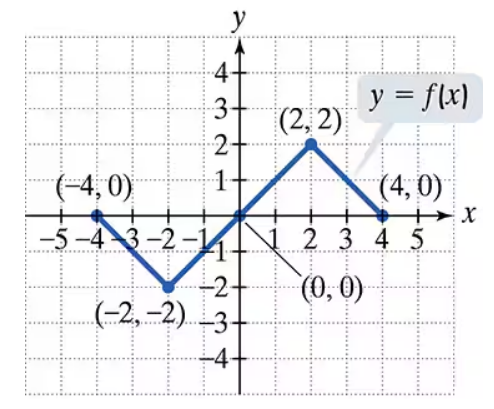
 Verified step by step guidance
 4:22
4:22