use the graph of y = f(x) to graph each function g. g(x) = f(x-1)
Verified step by step guidance
1
Identify the given function and the transformation: The original function is \(y = f(x)\), and the new function is \(g(x) = f(x - 1)\). This represents a horizontal shift of the graph of \(f(x)\).
Understand the effect of \(f(x - 1)\): Replacing \(x\) with \(x - 1\) shifts the graph of \(f(x)\) to the right by 1 unit. This means every point on the graph of \(f(x)\) moves 1 unit to the right to get the graph of \(g(x)\).
Apply the horizontal shift to key points: Take the key points from the original graph of \(f(x)\), which are \((-4, 0)\), \((0, -16)\), and \((4, 0)\). Add 1 to each x-coordinate to find the corresponding points on \(g(x)\).
Calculate the new points for \(g(x)\): The points become \((-4 + 1, 0) = (-3, 0)\), \((0 + 1, -16) = (1, -16)\), and \((4 + 1, 0) = (5, 0)\).
Sketch the graph of \(g(x)\): Plot the new points \((-3, 0)\), \((1, -16)\), and \((5, 0)\) on the coordinate plane and draw a smooth parabola through these points, maintaining the shape of the original graph but shifted right by 1 unit.
Verified video answer for a similar problem:
This video solution was recommended by our tutors as helpful for the problem above
Video duration:
2m
Play a video:
0 Comments
Key Concepts
Here are the essential concepts you must grasp in order to answer the question correctly.
Function Transformation - Horizontal Shift
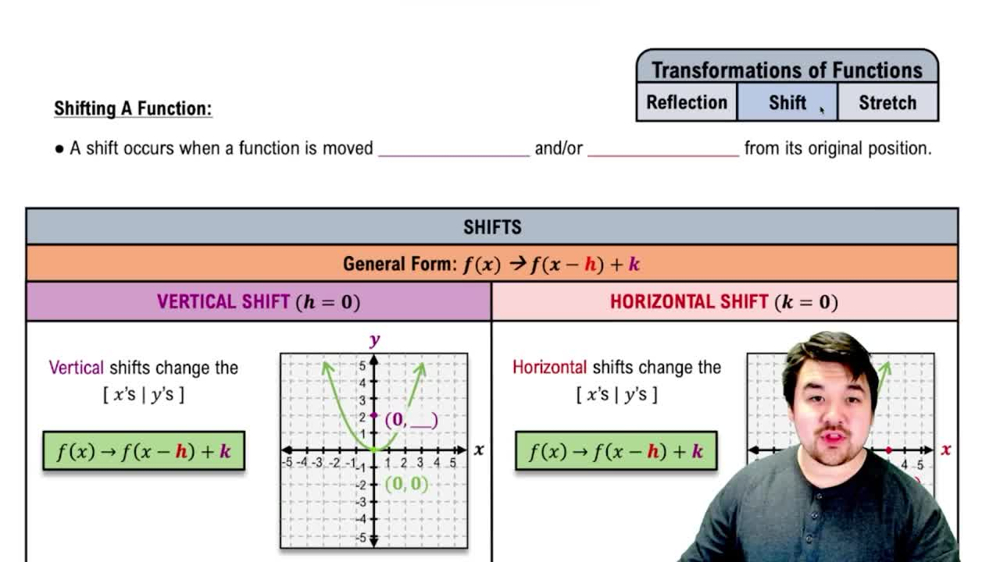
A horizontal shift of a function occurs when the input variable x is replaced by (x - h), shifting the graph h units to the right if h > 0, or to the left if h < 0. For g(x) = f(x - 1), the graph of f(x) moves 1 unit to the right.
Quadratic functions form parabolas, typically expressed as y = ax^2 + bx + c. Key points such as vertex and x-intercepts help in sketching the graph. The given graph shows a parabola with vertex at (0, -16) and x-intercepts at (-4, 0) and (4, 0).
Identifying and using key points like intercepts and vertex is essential for graph transformations. These points help visualize how the graph shifts or changes shape. For g(x) = f(x - 1), each key point of f(x) moves 1 unit right, e.g., vertex moves from (0, -16) to (1, -16).

 2:44 minutes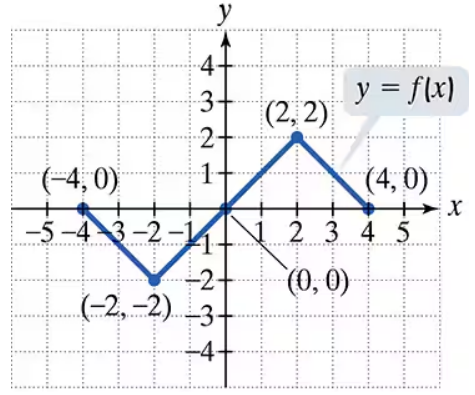
 Verified step by step guidance
 5:34
5:34