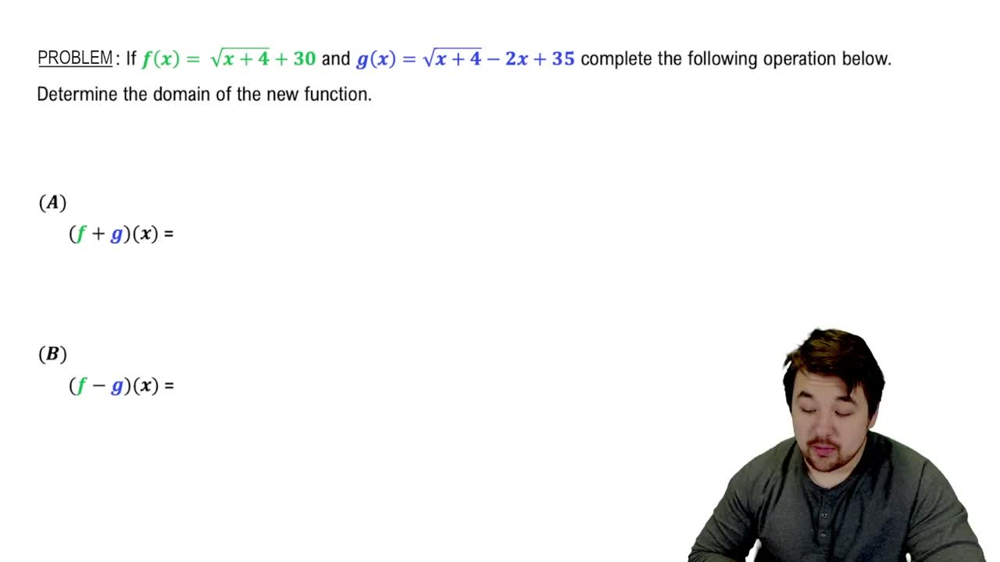
First, understand that (f+g)(x) means you add the functions f(x) and g(x) together, so (f+g)(x) = f(x) + g(x).
Write down the expressions for f(x) and g(x): f(x) = 3x^2 - 4 and g(x) = x^2 - 3x - 4.
Add the two functions together: (f+g)(x) = (3x^2 - 4) + (x^2 - 3x - 4).
Combine like terms in the expression: combine the x^2 terms, the x terms, and the constant terms.
After simplifying, substitute x with 2k in the resulting expression to find (f+g)(2k).
Verified video answer for a similar problem:
This video solution was recommended by our tutors as helpful for the problem above
Video duration:
2m
Play a video:
0 Comments
Key Concepts
Here are the essential concepts you must grasp in order to answer the question correctly.
Function Addition
Function addition involves creating a new function by adding the outputs of two given functions for the same input. For functions f and g, (f+g)(x) = f(x) + g(x). This operation combines the values of f and g at each point x.
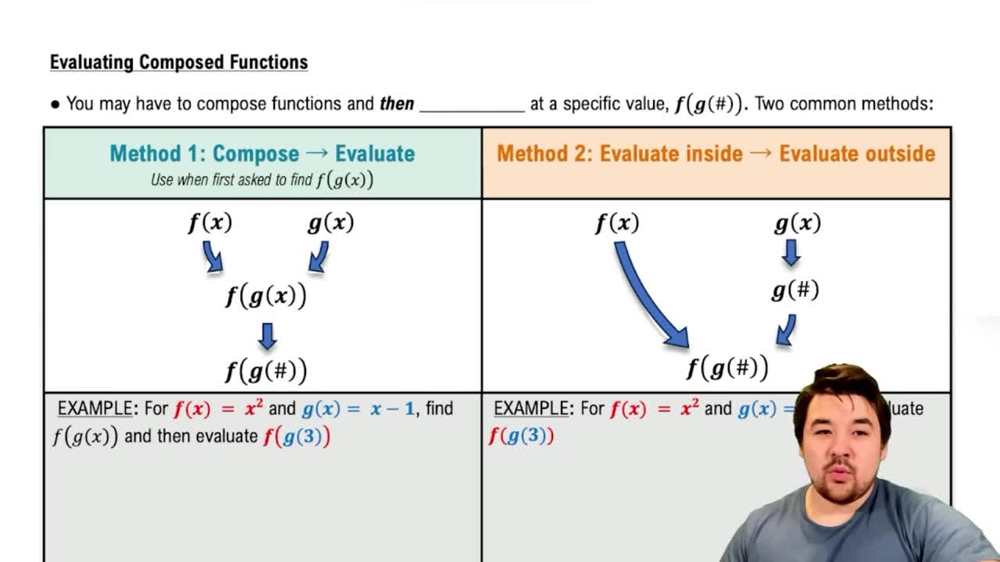
Function evaluation means substituting a specific input value into the function's formula to find the output. For example, to evaluate f(2k), replace every x in f(x) with 2k and simplify the expression.
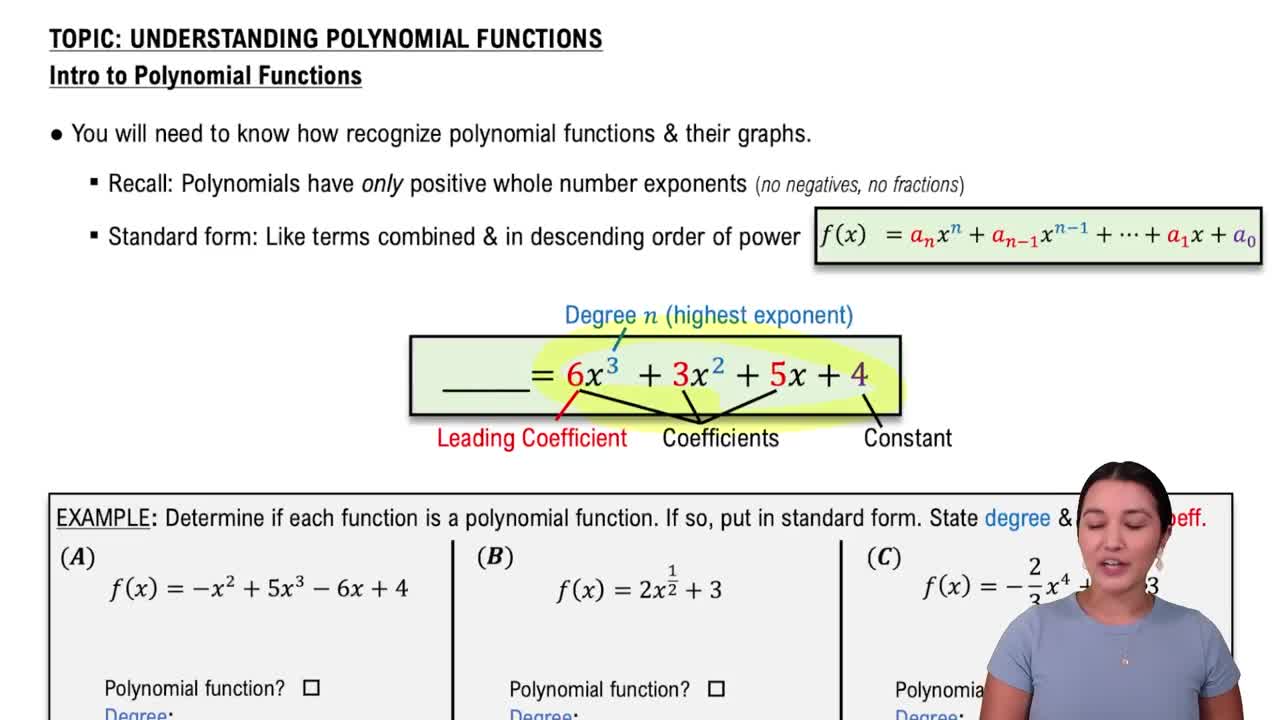
Polynomial functions are expressions involving variables raised to whole-number exponents with coefficients. Understanding how to manipulate and simplify polynomials, such as squaring binomials and combining like terms, is essential for evaluating and adding functions like f(x) and g(x).

 2:57 minutes
 Verified step by step guidance
 4:46
4:46