Solve each equation in Exercises 15–34 by the square root property.
Verified step by step guidance
1
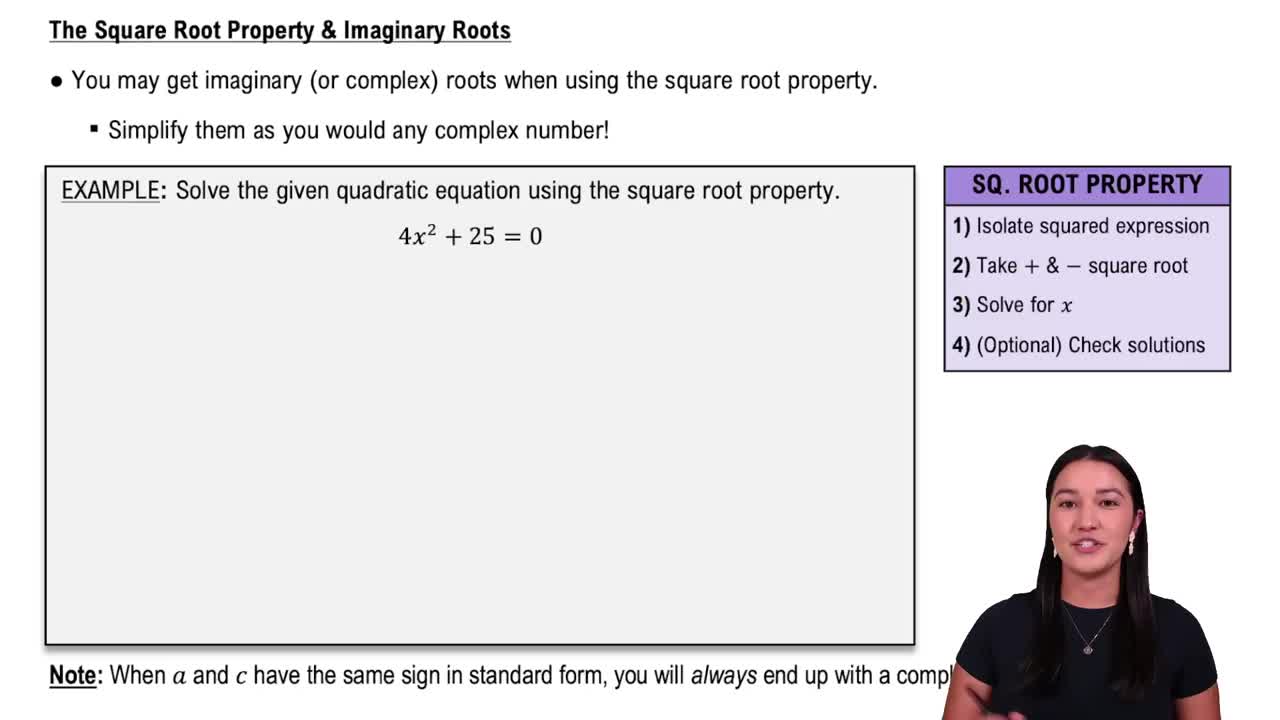
Recognize that the equation is in the form \( (x + 3)^2 = -16 \), which is suitable for applying the square root property. The square root property states that if \( A^2 = B \), then \( A = \pm \sqrt{B} \).
Apply the square root property to both sides of the equation: \( x + 3 = \pm \sqrt{-16} \).
Recall that the square root of a negative number involves imaginary numbers. Express \( \sqrt{-16} \) as \( \sqrt{16} \times \sqrt{-1} \), which simplifies to \( 4i \), where \( i \) is the imaginary unit.
Rewrite the equation using this simplification: \( x + 3 = \pm 4i \).
Isolate \( x \) by subtracting 3 from both sides: \( x = -3 \pm 4i \). This gives the two complex solutions.
Verified video answer for a similar problem:
This video solution was recommended by our tutors as helpful for the problem above
Video duration:
2m
Play a video:
0 Comments
Key Concepts
Here are the essential concepts you must grasp in order to answer the question correctly.
Square Root Property
The square root property states that if an equation is in the form (x + a)^2 = b, then x + a = ±√b. This allows solving quadratic equations by isolating the squared term and taking the square root of both sides, considering both positive and negative roots.
When the equation involves the square root of a negative number, solutions are complex numbers. The imaginary unit i is defined as √(-1), enabling the expression of roots of negative numbers as multiples of i, such as √(-16) = 4i.
Before applying the square root property, the equation must be manipulated to isolate the squared term on one side. This often involves adding or subtracting constants and ensures the equation is in the correct form for taking square roots.