Solve each equation in Exercises 47–64 by completing the square.
Verified step by step guidance
1
Start with the given equation: \(x^2 + 6x = 7\).
To complete the square, take half of the coefficient of \(x\), which is \$6\(, divide it by \)2\( to get \)3\(, and then square it to get \)3^2 = 9$.
Add \$9\( to both sides of the equation to maintain equality: \)x^2 + 6x + 9 = 7 + 9$.
Rewrite the left side as a perfect square trinomial: \((x + 3)^2 = 16\).
Take the square root of both sides, remembering to include both the positive and negative roots: \(x + 3 = \pm 4\), then solve for \(x\) by isolating it.
Verified video answer for a similar problem:
This video solution was recommended by our tutors as helpful for the problem above
Video duration:
4m
Play a video:
0 Comments
Key Concepts
Here are the essential concepts you must grasp in order to answer the question correctly.
Completing the Square
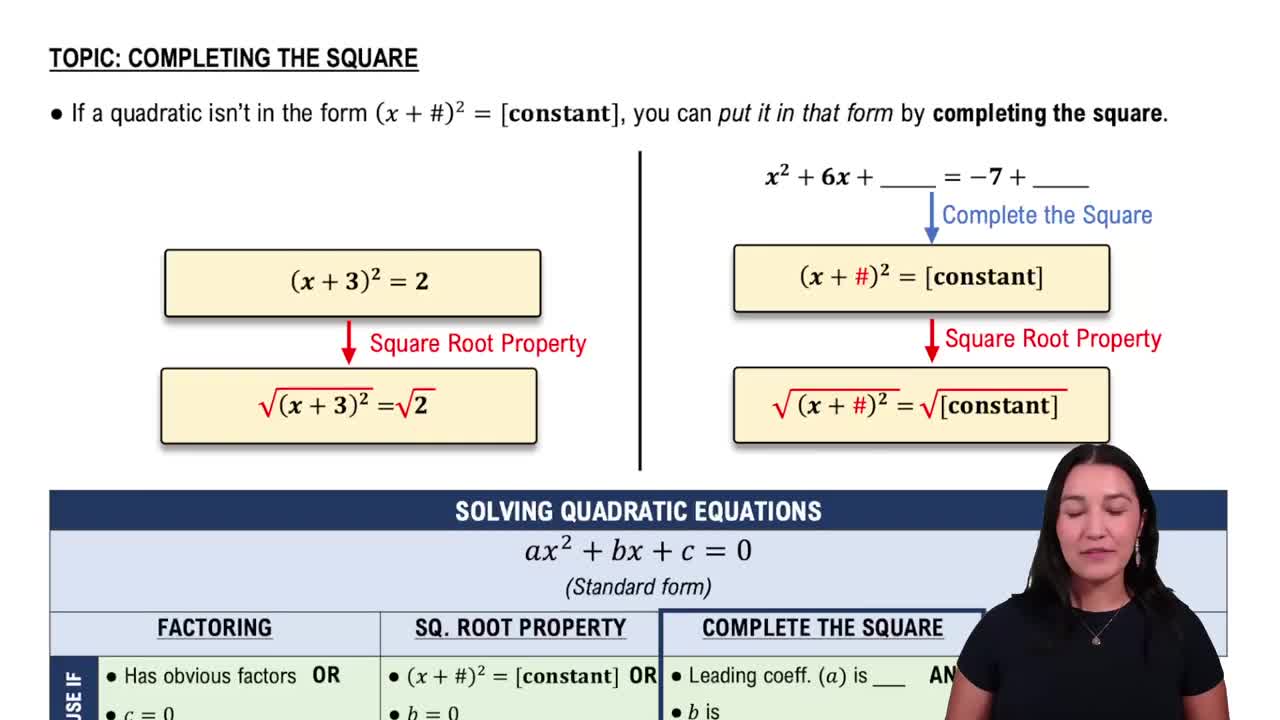
Completing the square is a method used to solve quadratic equations by transforming the equation into a perfect square trinomial. This involves adding a specific value to both sides of the equation to create a binomial squared, making it easier to solve for the variable.
Solving Quadratic Equations by Completing the Square
Quadratic Equations
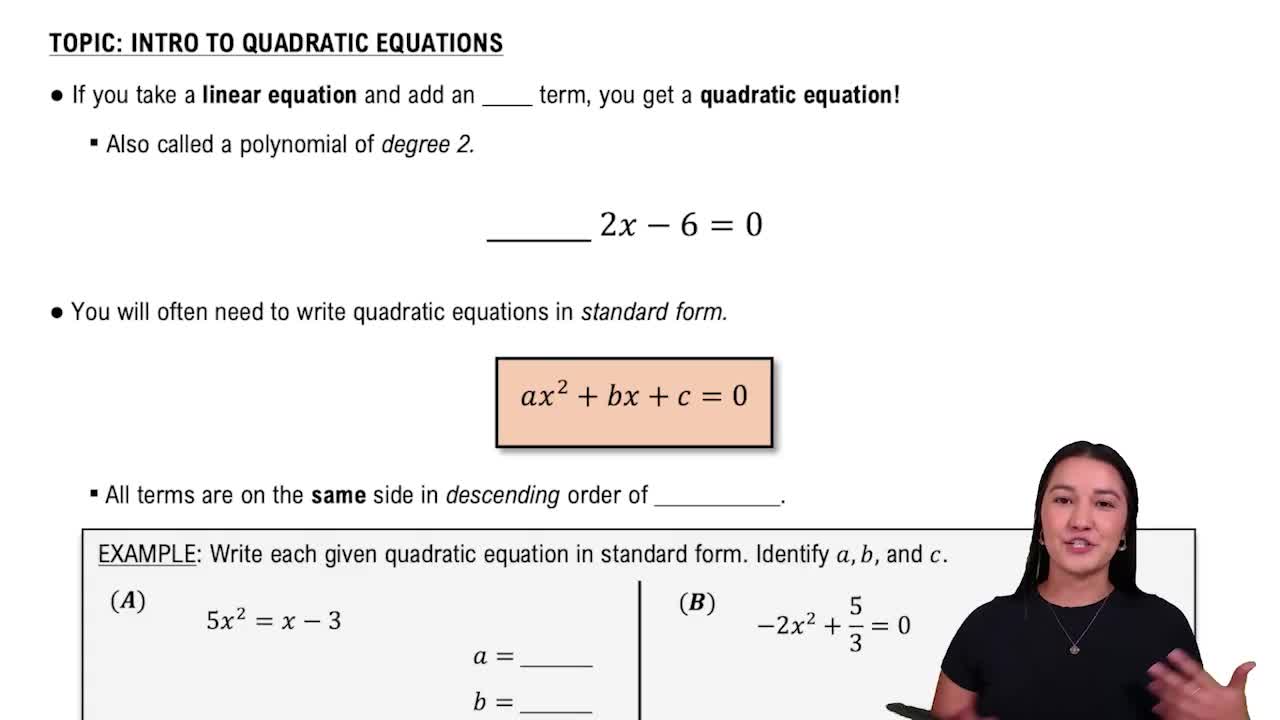
A quadratic equation is a second-degree polynomial equation in the form ax² + bx + c = 0. Understanding its structure is essential for applying methods like completing the square, factoring, or using the quadratic formula to find the roots.
Isolating the variable involves rearranging the equation so that the variable term is alone on one side. This step is crucial before completing the square, as it allows you to manipulate the equation properly and solve for the unknown.

 4:39 minutes
 Verified step by step guidance
 06:24
06:24