Factor out the greatest common factor from each polynomial. See Example 1. 2(m-1)-3(m-1)2+2(m-1)3
Verified step by step guidance
1
Identify the greatest common factor (GCF) in all the terms of the polynomial. Here, each term contains a factor of \((m-1)\) raised to some power.
Determine the smallest power of \((m-1)\) present in all terms. The terms are \$2(m-1)\(, \)-3(m-1)^2\(, and \)2(m-1)^3$, so the smallest power is 1.
Factor out \((m-1)\) from each term. This means rewriting each term as a product of \((m-1)\) and another expression: \(2(m-1) = 2 \cdot (m-1)\), \(-3(m-1)^2 = -3(m-1) \cdot (m-1)\), and \(2(m-1)^3 = 2(m-1) \cdot (m-1)^2\).
Write the polynomial as \((m-1)\) times the sum of the remaining factors: \((m-1) \left[ 2 - 3(m-1) + 2(m-1)^2 \right]\).
Simplify the expression inside the brackets if possible by expanding or combining like terms to get the fully factored form.
Verified video answer for a similar problem:
This video solution was recommended by our tutors as helpful for the problem above
Video duration:
5m
Play a video:
0 Comments
Key Concepts
Here are the essential concepts you must grasp in order to answer the question correctly.
Greatest Common Factor (GCF)
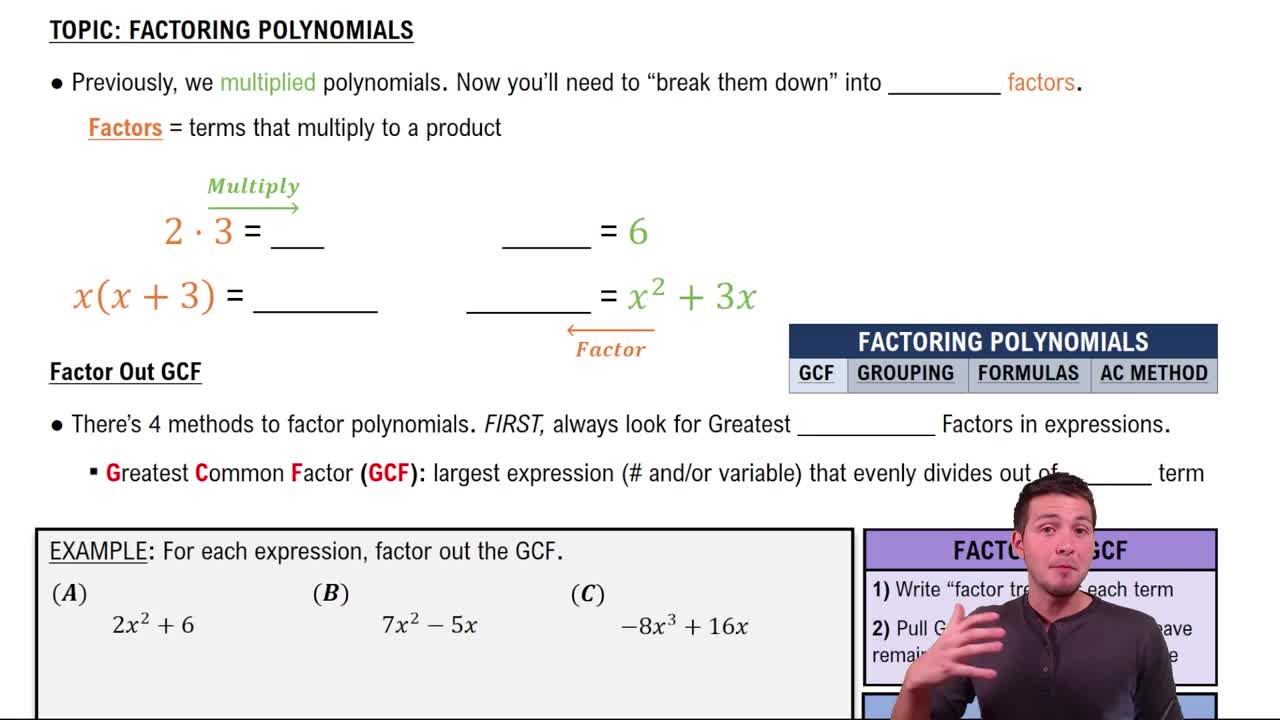
The Greatest Common Factor is the largest expression that divides each term of a polynomial without leaving a remainder. Factoring out the GCF simplifies the polynomial and is the first step in many factoring problems. Identifying the GCF involves finding common numerical coefficients and variable factors shared by all terms.
Factoring polynomials means rewriting them as a product of simpler expressions. This process often starts by extracting the GCF, which reduces the polynomial to a simpler form. Factoring helps solve equations, simplify expressions, and analyze polynomial behavior.
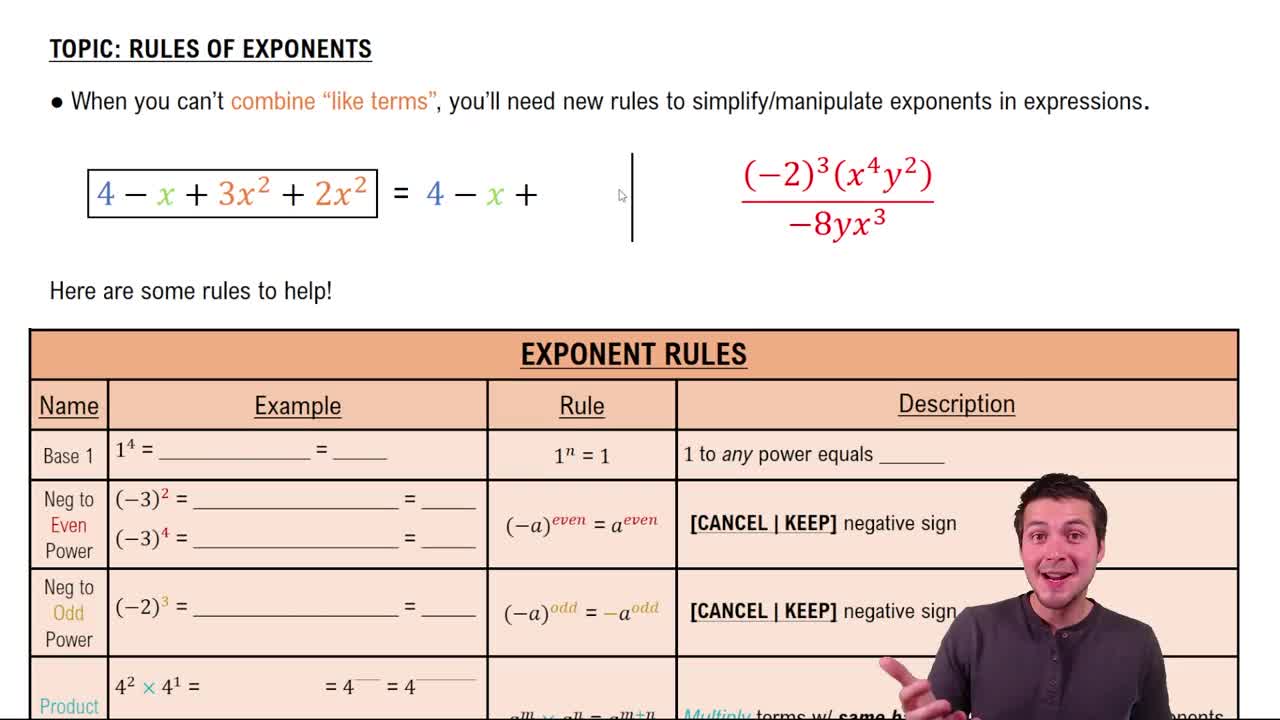
Understanding how to handle powers and exponents is essential when factoring polynomials with terms like (m-1), (m-1)^2, and (m-1)^3. Recognizing that these terms share a common base allows you to factor out the lowest power, simplifying the expression effectively.