In Exercises 23–34, factor out the negative of the greatest common factor.−4x + 12
Verified step by step guidance
1
Identify the terms in the expression: \(-4x\) and \(12\).
Determine the greatest common factor (GCF) of the coefficients \(-4\) and \(12\). The GCF is \(4\).
Since the problem asks to factor out the negative of the GCF, use \(-4\) as the factor.
Rewrite each term by factoring out \(-4\): \(-4(x) + 12 = -4(x - 3)\).
Express the factored form as \(-4(x - 3)\).
Verified video answer for a similar problem:
This video solution was recommended by our tutors as helpful for the problem above
Video duration:
3m
Play a video:
0 Comments
Key Concepts
Here are the essential concepts you must grasp in order to answer the question correctly.
Greatest Common Factor (GCF)
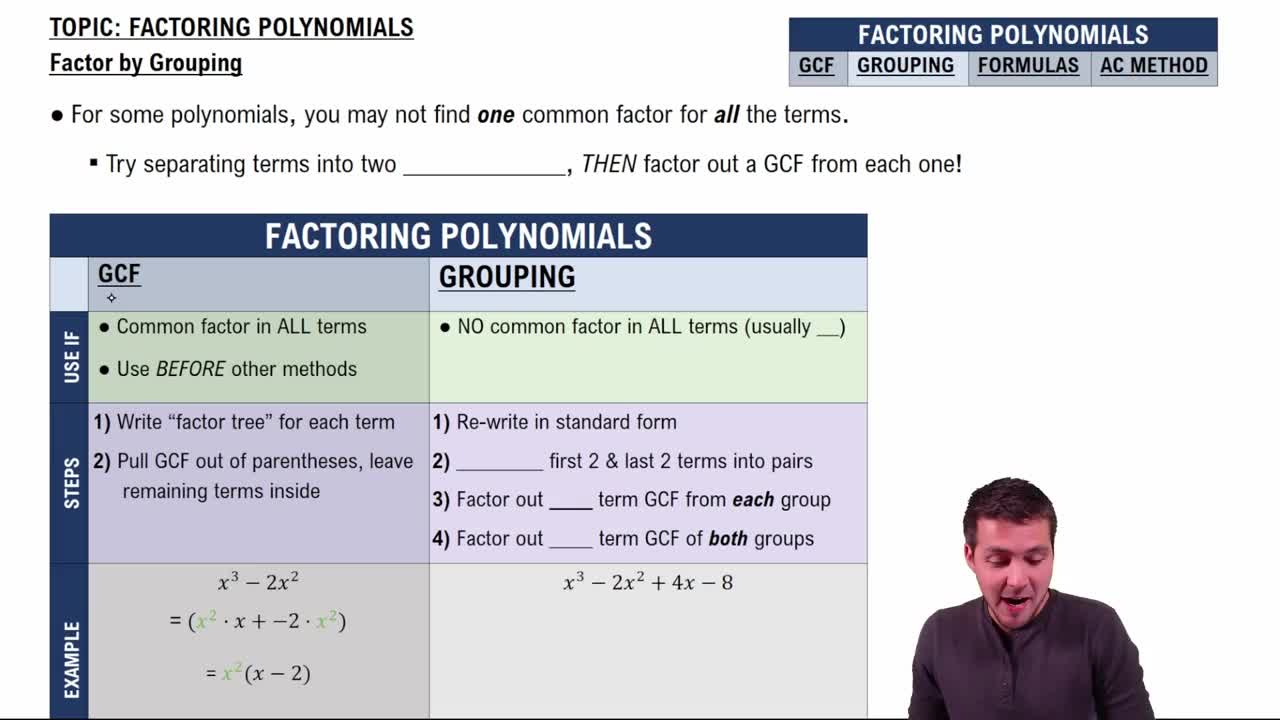
The Greatest Common Factor (GCF) is the largest integer that divides each of the given numbers without leaving a remainder. In algebraic expressions, the GCF can also refer to the highest degree of common variables. Identifying the GCF is essential for simplifying expressions and factoring them correctly.
Factoring is the process of breaking down an expression into a product of simpler expressions or factors. This is a fundamental skill in algebra that allows for easier manipulation and solving of equations. In this case, factoring out the GCF helps to simplify the expression and make it easier to work with.
A negative factor is a factor that is less than zero, which can change the signs of the terms in an expression when factored out. In the context of the given problem, factoring out the negative of the GCF means that the resulting expression will have its terms adjusted accordingly, which is crucial for maintaining the equality of the expression.

 3:21 minutes
 Verified step by step guidance
 5:57
5:57