Factor out the greatest common factor from each polynomial. See Example 1. (4z-5)(3z-2)-(3z-9)(3z-2)
Verified step by step guidance
1
Identify the expression to factor: \( (4z - 5)(3z - 2) - (3z - 9)(3z - 2) \).
Notice that both terms contain the common binomial factor \( (3z - 2) \). This is the greatest common factor (GCF) of the two terms.
Factor out the GCF \( (3z - 2) \) from the entire expression, rewriting it as \( (3z - 2) \left[ (4z - 5) - (3z - 9) \right] \).
Simplify the expression inside the brackets by distributing the negative sign: \( (4z - 5) - (3z - 9) = 4z - 5 - 3z + 9 \).
Combine like terms inside the brackets to get \( (4z - 3z) + (-5 + 9) \), which simplifies to \( z + 4 \). So the factored form is \( (3z - 2)(z + 4) \).
Verified video answer for a similar problem:
This video solution was recommended by our tutors as helpful for the problem above
Video duration:
3m
Play a video:
0 Comments
Key Concepts
Here are the essential concepts you must grasp in order to answer the question correctly.
Greatest Common Factor (GCF)
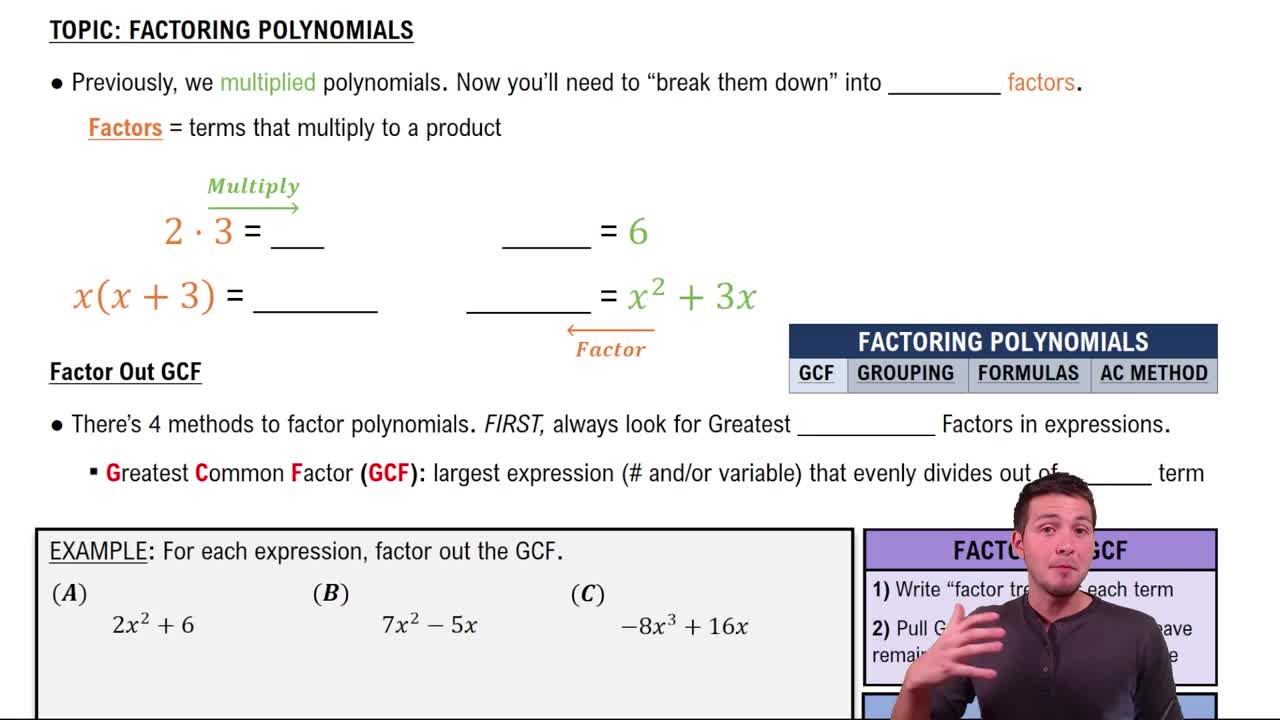
The Greatest Common Factor is the largest expression that divides two or more terms or polynomials without leaving a remainder. Factoring out the GCF simplifies expressions and is the first step in many factoring problems. For example, in 6x and 9x², the GCF is 3x.
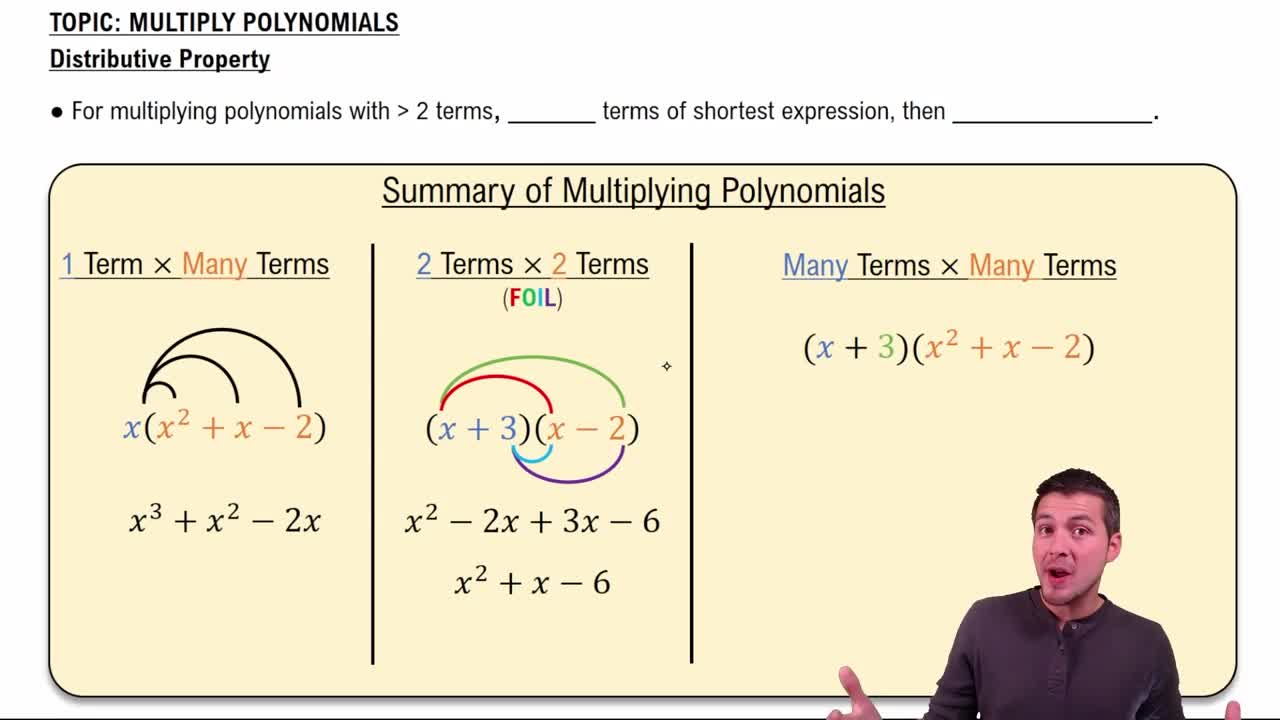
The distributive property states that a(b + c) = ab + ac. It allows you to factor expressions by reversing distribution, extracting common factors from terms. In the given problem, recognizing common binomial factors helps in factoring the entire expression.
Multiply Polynomials Using the Distributive Property
Factoring Polynomials
Factoring polynomials involves rewriting them as a product of simpler polynomials or factors. This process often starts by identifying and factoring out the GCF, then applying other methods if needed. It simplifies expressions and solves equations efficiently.