An equation that defines y as a function of x is given. Find ƒ(3). y+2x2=3-x
Verified step by step guidance
1
Start with the given equation: \(y + 2x^{2} = 3 - x\).
Isolate \(y\) on one side to express it as a function of \(x\): subtract \$2x^{2}\( from both sides to get \)y = 3 - x - 2x^{2}$.
Rewrite the function notation as \(f(x) = 3 - x - 2x^{2}\) to clearly show \(y\) as a function of \(x\).
To find \(f(3)\), substitute \(x = 3\) into the function: \(f(3) = 3 - (3) - 2(3)^{2}\).
Simplify the expression step-by-step by calculating the powers and performing the arithmetic to find the value of \(f(3)\).
Verified video answer for a similar problem:
This video solution was recommended by our tutors as helpful for the problem above
Video duration:
1m
Play a video:
0 Comments
Key Concepts
Here are the essential concepts you must grasp in order to answer the question correctly.
Function Notation and Evaluation
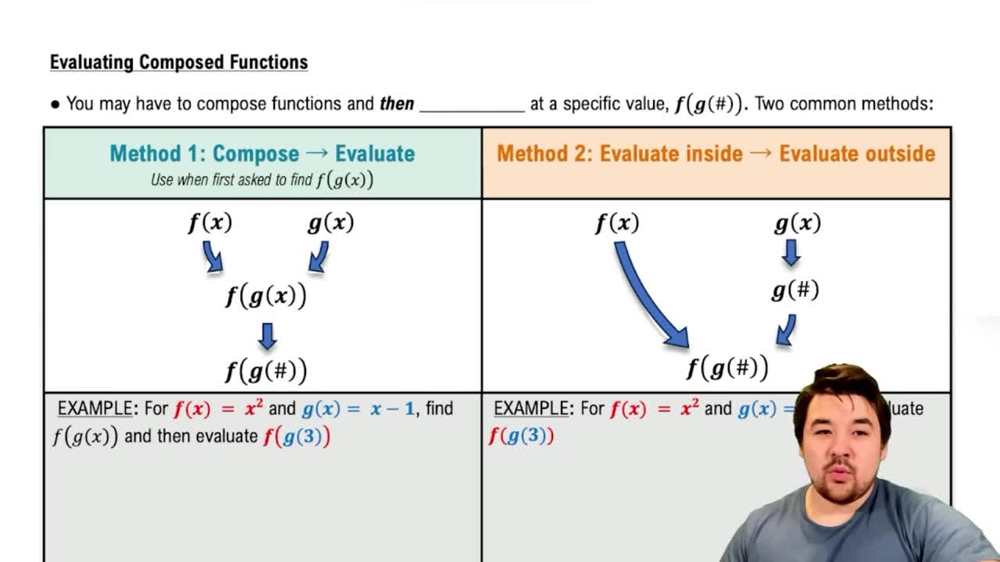
Function notation, such as ƒ(x), represents a rule that assigns each input x to exactly one output y. Evaluating ƒ(3) means substituting x = 3 into the function's equation and calculating the corresponding y-value.
To find ƒ(3), the equation must be rewritten to express y explicitly as a function of x. This involves isolating y on one side of the equation, often by performing algebraic operations like addition, subtraction, or division.
After expressing y as a function of x, substitution involves replacing x with the given value (here, 3) to compute the specific output. This step is essential to find the function's value at a particular input.

 1:34 minutes
 Verified step by step guidance
 4:26
4:26