Find the value of the function for the given value of x. ƒ(x)=-[[-x]], for x=2.5
Verified step by step guidance
1
Identify the given function: \(f(x) = -\left\lfloor -x \right\rfloor\), where \(\left\lfloor \cdot \right\rfloor\) denotes the floor function, which means rounding down to the greatest integer less than or equal to the value inside.
Substitute the given value \(x = 2.5\) into the function: \(f(2.5) = -\left\lfloor -2.5 \right\rfloor\).
Evaluate the expression inside the floor function: calculate \(-2.5\).
Find the floor of \(-2.5\), which is the greatest integer less than or equal to \(-2.5\).
Apply the negative sign outside the floor function to the result from step 4 to find \(f(2.5)\).
Verified video answer for a similar problem:
This video solution was recommended by our tutors as helpful for the problem above
Video duration:
3m
Play a video:
0 Comments
Key Concepts
Here are the essential concepts you must grasp in order to answer the question correctly.
Function Evaluation
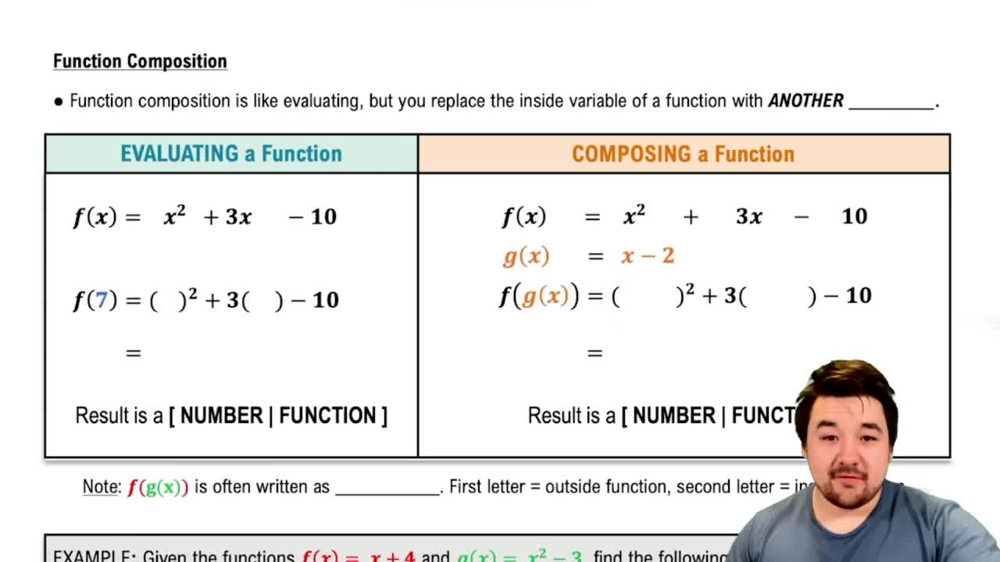
Function evaluation involves substituting a given input value into the function's expression and simplifying to find the output. For example, if ƒ(x) = expression, then ƒ(2.5) means replacing x with 2.5 and calculating the result.
The floor function, denoted by [[x]] or ⌊x⌋, returns the greatest integer less than or equal to x. For instance, ⌊2.5⌋ = 2 and ⌊-2.5⌋ = -3. Understanding this is crucial for evaluating functions involving floor notation.
When a function includes a negative sign outside the floor function, such as -[[ -x ]], it means first apply the floor function to -x, then multiply the result by -1. This order affects the final value and must be carefully followed.

 3:07 minutes
 Verified step by step guidance
 4:26
4:26