Find f−g and determine the domain for each function. f(x) = 2x² − x − 3, g (x) = x + 1
Verified step by step guidance
1
Step 1: Understand the problem. You are tasked with finding the difference of two functions, f(x) and g(x), denoted as (f−g)(x). This means subtracting g(x) from f(x). Additionally, you need to determine the domain of the resulting function.
Step 2: Write the expression for (f−g)(x). Subtract g(x) from f(x): (f−g)(x) = f(x) − g(x). Substitute the given functions: f(x) = 2x² − x − 3 and g(x) = x + 1. The subtraction becomes: (f−g)(x) = (2x² − x − 3) − (x + 1).
Step 3: Simplify the expression. Distribute the negative sign across g(x): (f−g)(x) = 2x² − x − 3 − x − 1. Combine like terms: (f−g)(x) = 2x² − 2x − 4.
Step 4: Determine the domain of the resulting function. The domain of a function is the set of all x-values for which the function is defined. Since (f−g)(x) = 2x² − 2x − 4 is a polynomial, and polynomials are defined for all real numbers, the domain is all real numbers, or (-∞, ∞).
Step 5: Summarize the results. The difference of the functions is (f−g)(x) = 2x² − 2x − 4, and the domain of the resulting function is all real numbers, (-∞, ∞).
Verified video answer for a similar problem:
This video solution was recommended by our tutors as helpful for the problem above
Video duration:
5m
Play a video:
0 Comments
Key Concepts
Here are the essential concepts you must grasp in order to answer the question correctly.
Function Subtraction
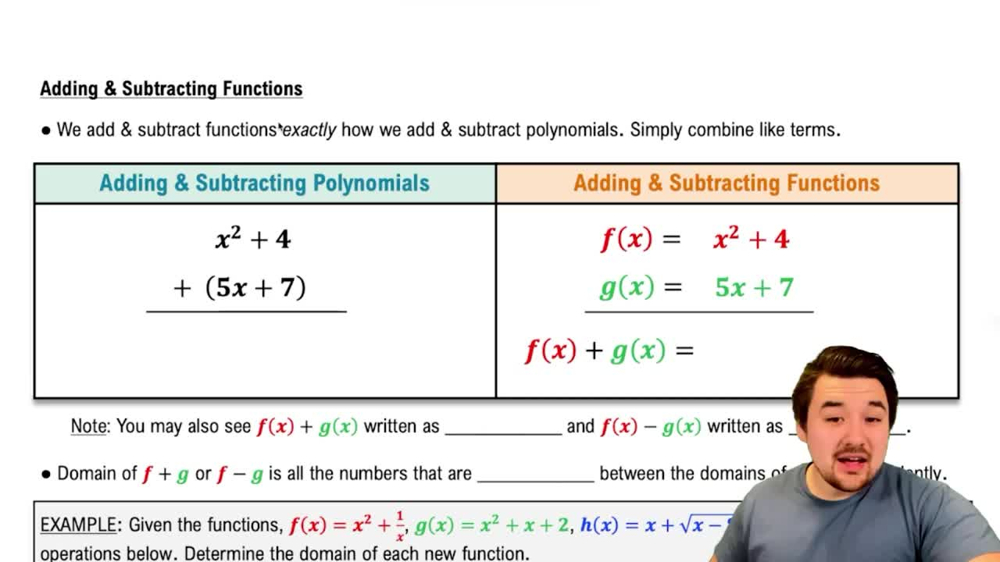
Function subtraction involves taking two functions, f(x) and g(x), and creating a new function, f-g, defined as (f-g)(x) = f(x) - g(x). This operation requires substituting the expressions of f and g into the equation and simplifying the result to find the new function.
The domain of a function is the set of all possible input values (x-values) for which the function is defined. When subtracting functions, the domain of the resulting function f-g is determined by the intersection of the domains of f and g, ensuring that all x-values are valid for both original functions.
A quadratic function is a polynomial function of degree two, typically expressed in the form f(x) = ax² + bx + c. The function f(x) = 2x² - x - 3 is a quadratic function, and its properties, such as its vertex and axis of symmetry, can influence the overall behavior of the function when combined with another function like g(x).

 5:00 minutes
 Verified step by step guidance
 5:56
5:56