Distribute the negative sign across the parentheses: \(3\sqrt{7} - 4\sqrt{7} + i - 4i - 2\sqrt{7} + 5i\).
Group the like terms together: group all terms with \(\sqrt{7}\) and all terms with \(i\) separately: \((3\sqrt{7} - 4\sqrt{7} - 2\sqrt{7}) + (i - 4i + 5i)\).
Combine the coefficients of the \(\sqrt{7}\) terms: \$3 - 4 - 2\(, and combine the coefficients of the \)i\( terms: \)1 - 4 + 5$.
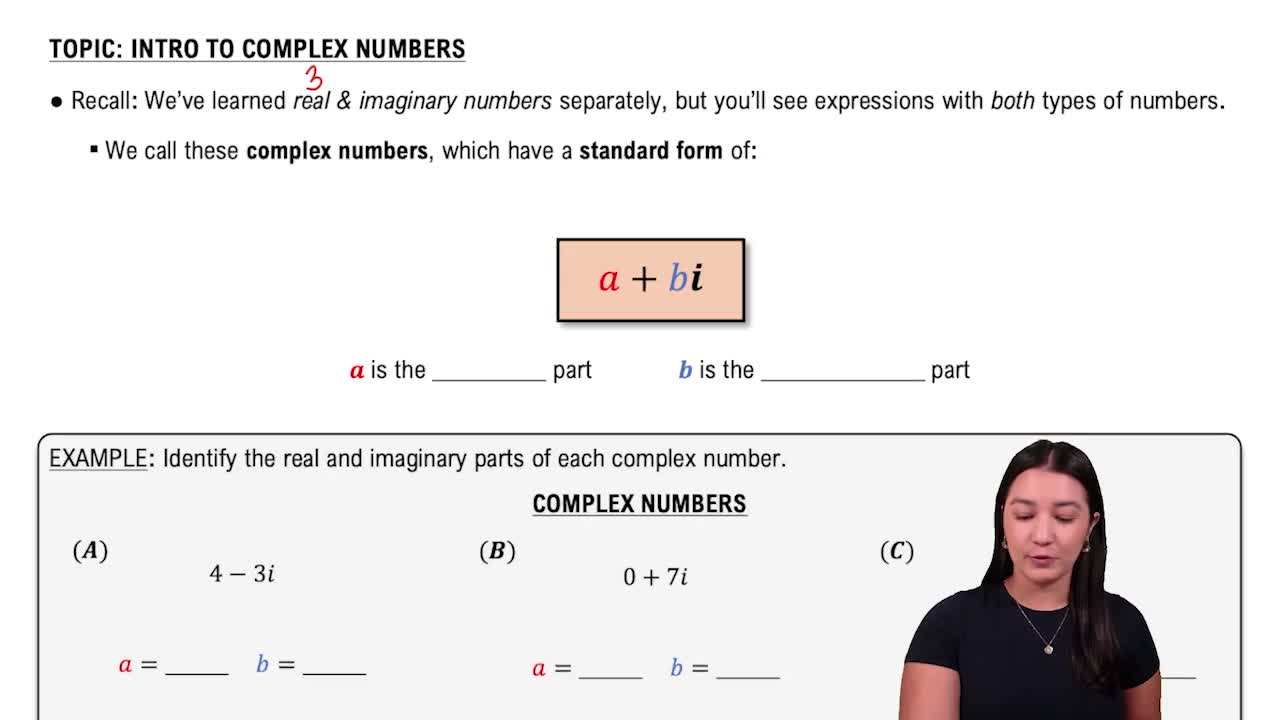
Write the final expression in standard form as \(a\sqrt{7} + bi\), where \(a\) and \(b\) are the simplified coefficients from the previous step.
Verified video answer for a similar problem:
This video solution was recommended by our tutors as helpful for the problem above
Video duration:
3m
Play a video:
0 Comments
Key Concepts
Here are the essential concepts you must grasp in order to answer the question correctly.
Simplifying Expressions with Radicals
This involves combining like terms that contain square roots, such as √7. Terms with the same radical part can be added or subtracted by operating on their coefficients, similar to combining like terms in algebra.
To simplify an expression, group and combine terms that have the same variable or radical part. For example, combine all terms with √7 separately from terms with i, ensuring the expression is simplified correctly.
The standard form of a complex number is a + bi, where a and b are real numbers. After simplifying, express the result by separating the real part and the imaginary part clearly, making it easier to interpret and use.

 3:18 minutes
 Verified step by step guidance
 05:45
05:45