Next, distribute the subtraction sign to the second group: \((-4 - i) - 2 - 3i + (-4 + 5i)\).
Now, group the real parts together and the imaginary parts together: \((-4 - 2 - 4) + (-i - 3i + 5i)\).
Combine the real parts: \(-4 - 2 - 4\) and combine the imaginary parts: \(-1i - 3i + 5i\).
Write the final answer in standard form \(a + bi\) by putting the combined real part and imaginary part together.
Verified video answer for a similar problem:
This video solution was recommended by our tutors as helpful for the problem above
Video duration:
2m
Play a video:
0 Comments
Key Concepts
Here are the essential concepts you must grasp in order to answer the question correctly.
Complex Numbers and Standard Form
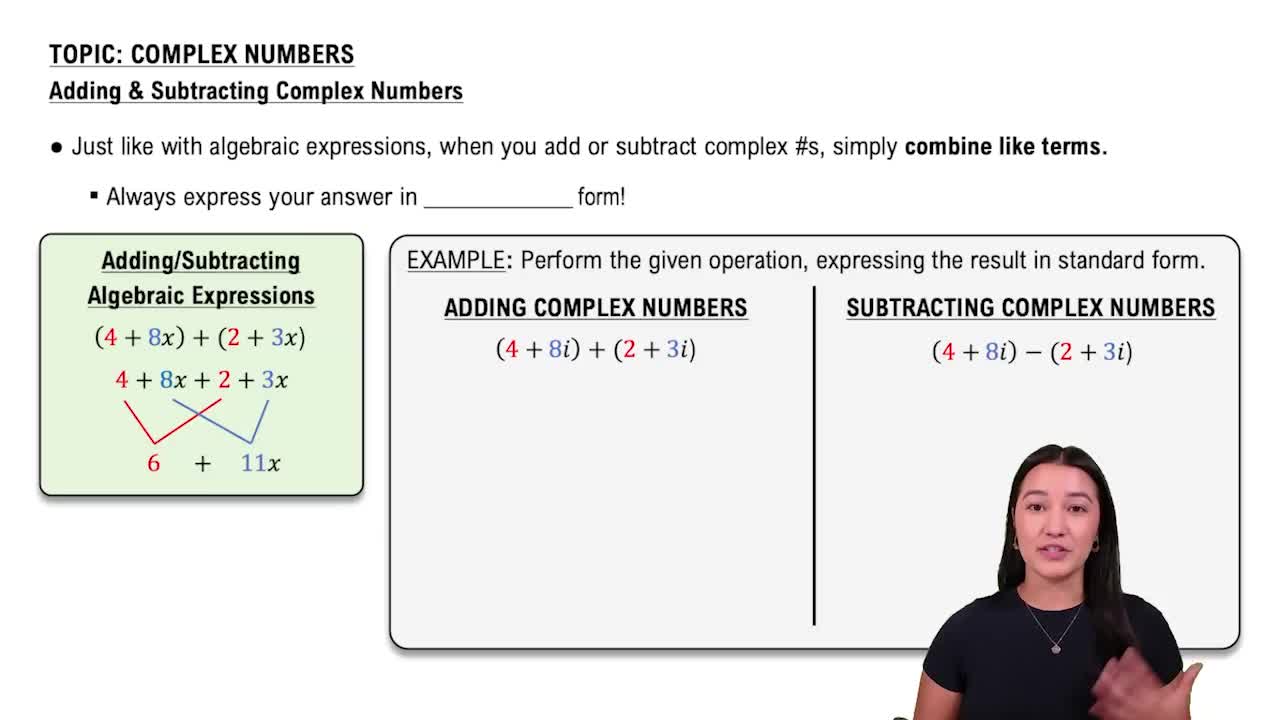
Complex numbers are expressed in the form a + bi, where a is the real part and b is the imaginary part. Writing answers in standard form means presenting the result explicitly as a sum of a real number and an imaginary number.
To add or subtract complex numbers, combine their real parts separately and their imaginary parts separately. This process treats the imaginary unit i as a variable, ensuring the real and imaginary components are handled independently.
When dealing with sums and differences of complex numbers, use the distributive property to remove parentheses and then group like terms (real with real, imaginary with imaginary) to simplify the expression efficiently.

 2:19 minutes
 Verified step by step guidance
 05:02
05:02