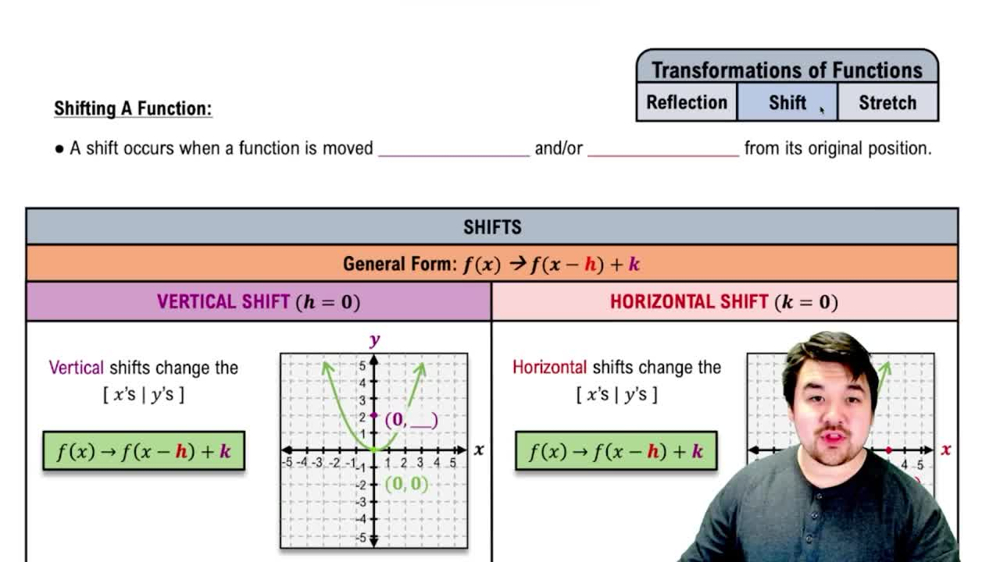
In Exercises 55–59, use the graph of to graph each function g. g(x) = f(x + 2) + 3
Verified step by step guidance
1
Identify the base function f(x) from the graph. Here, f(x) is an absolute value function with vertex at (0,0), forming a V-shape.
Understand the transformation in g(x) = f(x + 2) + 3. The term (x + 2) inside the function indicates a horizontal shift, and the +3 outside indicates a vertical shift.
Apply the horizontal shift: Replace x with (x + 2) shifts the graph of f(x) to the left by 2 units. This moves the vertex from (0,0) to (-2,0).
Apply the vertical shift: Adding +3 outside the function shifts the graph up by 3 units. This moves the vertex from (-2,0) to (-2,3).
Sketch the new graph g(x) by shifting every point of f(x) left 2 units and up 3 units, maintaining the same shape and slopes of the V.
Verified video answer for a similar problem:
This video solution was recommended by our tutors as helpful for the problem above
Video duration:
3m
Play a video:
0 Comments
Key Concepts
Here are the essential concepts you must grasp in order to answer the question correctly.
Function Transformations
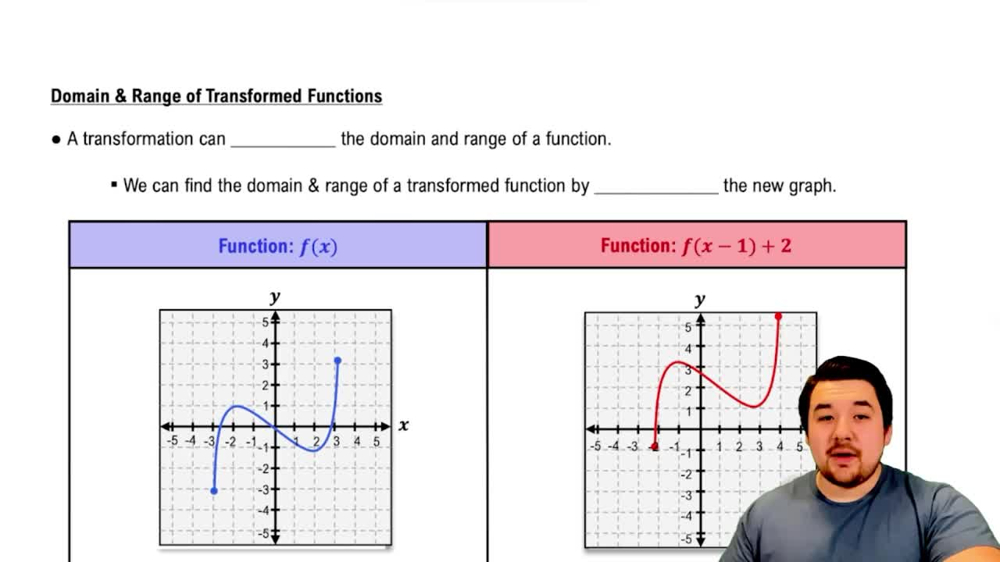
Function transformations involve shifting, stretching, compressing, or reflecting the graph of a function. In this problem, the function g(x) = f(x + 2) + 3 represents a horizontal shift left by 2 units and a vertical shift up by 3 units of the original function f(x). Understanding these shifts helps in graphing the transformed function accurately.
A horizontal shift occurs when the input variable x is replaced by (x + h) or (x - h). For g(x) = f(x + 2), the graph of f(x) shifts left by 2 units because adding inside the function moves the graph in the opposite direction of the sign. This concept is crucial for repositioning the vertex of the V-shaped graph.
A vertical shift happens when a constant is added or subtracted outside the function, such as f(x) + k. In g(x) = f(x + 2) + 3, adding 3 shifts the entire graph of f(x + 2) upward by 3 units. This moves the vertex and all points on the graph vertically, maintaining the shape but changing the position.

 3:18 minutes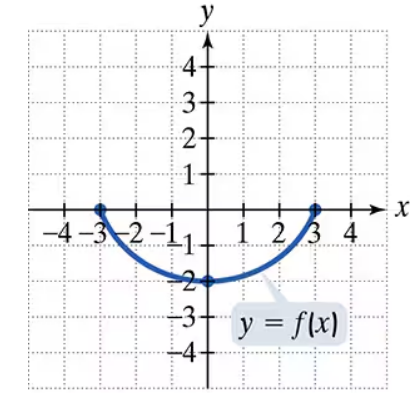
 Verified step by step guidance
 4:22
4:22