In Exercises 35–46, determine the constant that should be added to the binomial so that it becomes a perfect square trinomial. Then write and factor the trinomial.
Verified step by step guidance
1
Identify the coefficient of the linear term in the binomial. Here, the binomial is \(x^2 + 12x\), so the coefficient of \(x\) is 12.
To complete the square, take half of the coefficient of \(x\), which is \(\frac{12}{2} = 6\).
Square this value: \$6^2 = 36$. This is the constant that should be added to the binomial to make it a perfect square trinomial.
Add the constant to the binomial to form the trinomial: \(x^2 + 12x + 36\).
Write the trinomial as a squared binomial: \((x + 6)^2\).
Verified video answer for a similar problem:
This video solution was recommended by our tutors as helpful for the problem above
Video duration:
4m
Play a video:
0 Comments
Key Concepts
Here are the essential concepts you must grasp in order to answer the question correctly.
Perfect Square Trinomial
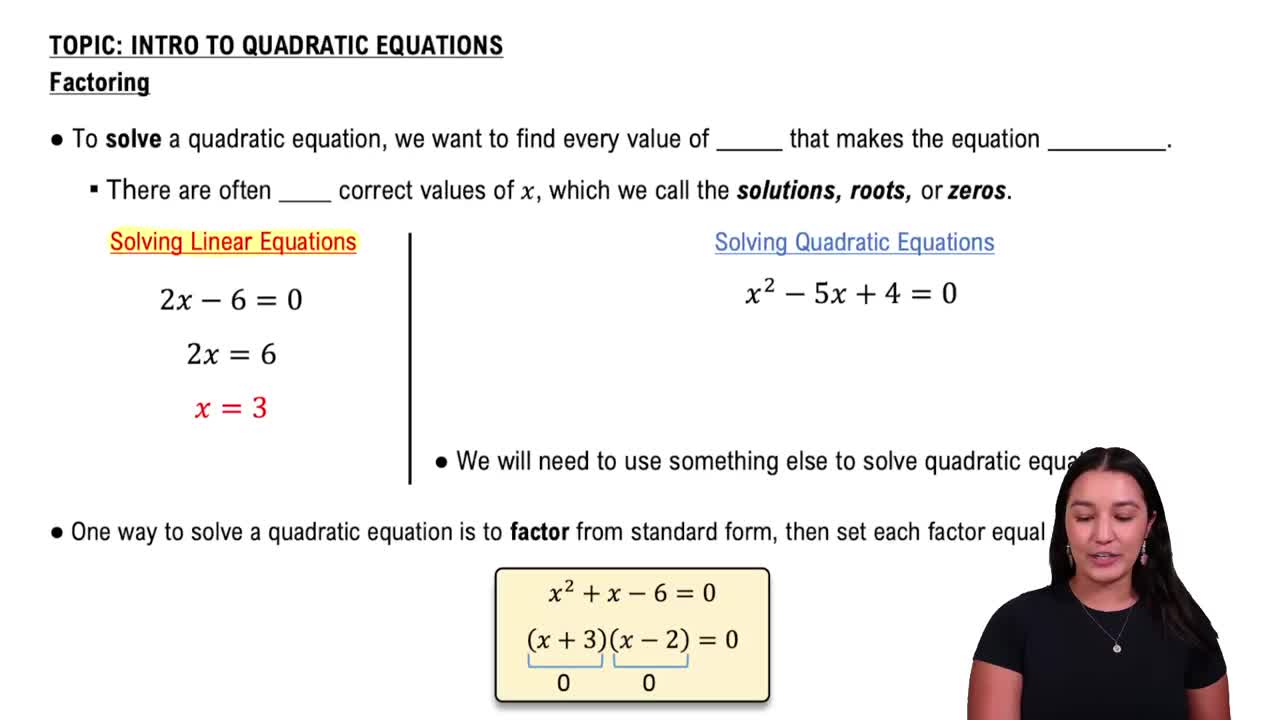
A perfect square trinomial is a quadratic expression that can be factored into the square of a binomial, typically in the form (x + a)^2 = x^2 + 2ax + a^2. Recognizing this form helps in rewriting and factoring quadratics efficiently.
Solving Quadratic Equations by Completing the Square
Completing the Square
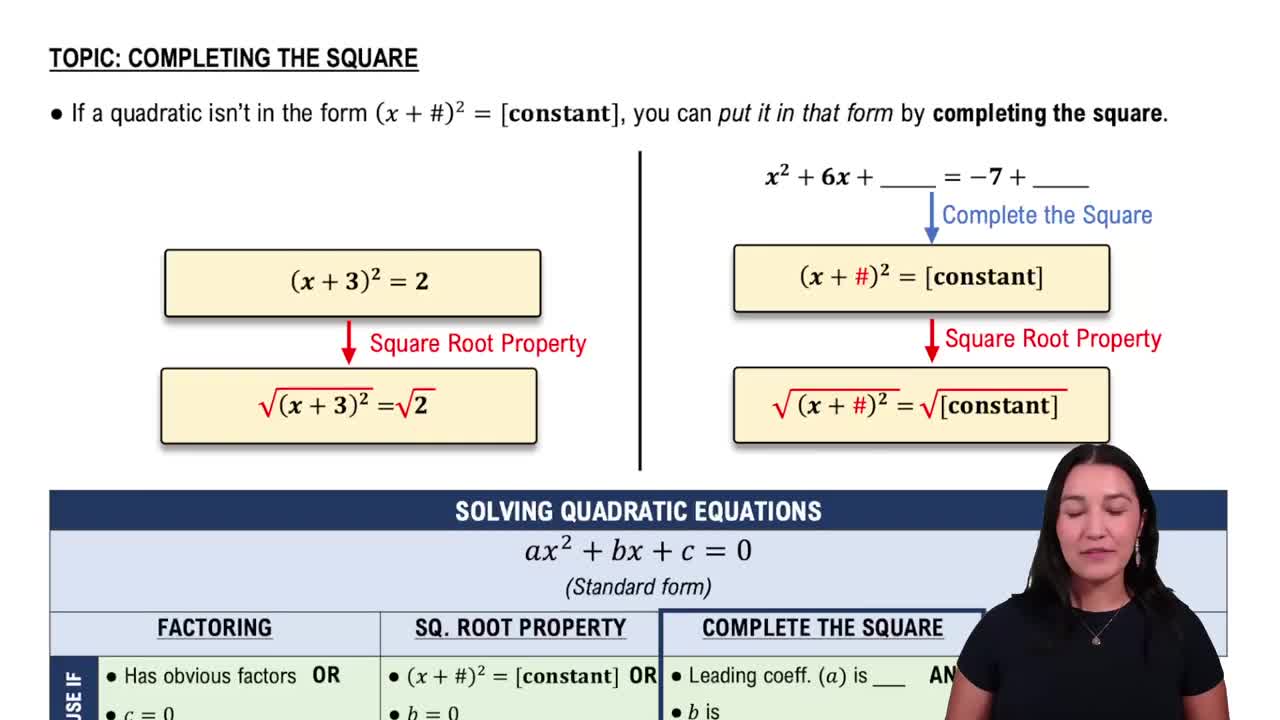
Completing the square involves adding a constant term to a quadratic expression to form a perfect square trinomial. This constant is found by taking half the coefficient of x, then squaring it, which allows the expression to be factored as a binomial squared.
Solving Quadratic Equations by Completing the Square
Factoring Quadratic Expressions
Factoring quadratic expressions means rewriting them as a product of binomials. For perfect square trinomials, this process simplifies to expressing the trinomial as (x + a)^2, which is useful for solving equations and analyzing functions.

 4:03 minutes
 Verified step by step guidance
 06:24
06:24