Find a. (fog) (2) b. (go f) (2) f(x) = 4-x, g(x) = 2x² +x+5
Verified step by step guidance
1
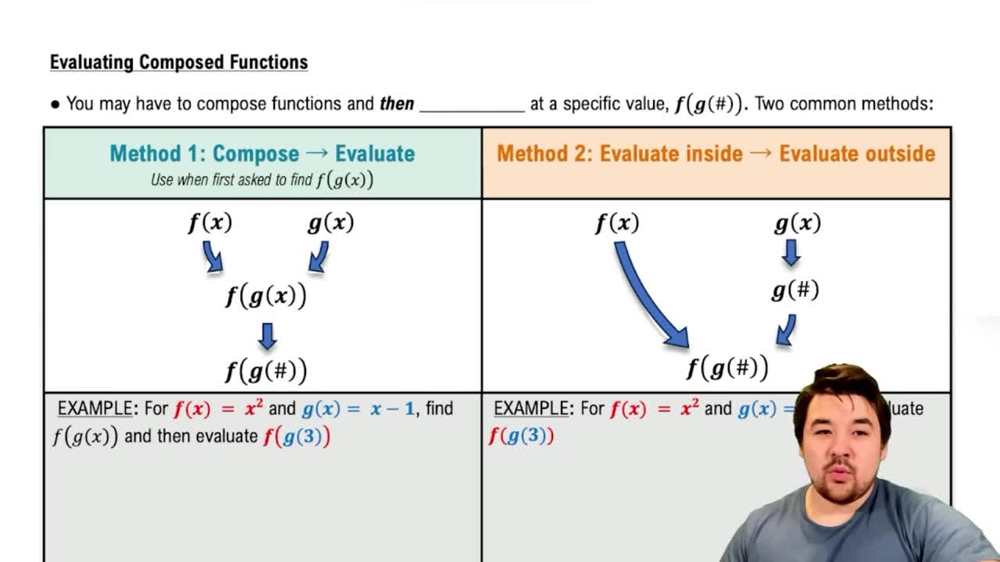
Step 1: Understand the problem. You are tasked with finding two composite function values: (f ∘ g)(2) and (g ∘ f)(2). Composite functions involve substituting one function into another. Specifically, (f ∘ g)(x) means f(g(x)), and (g ∘ f)(x) means g(f(x)).
Step 2: Start with part (a), (f ∘ g)(2). First, calculate g(2) by substituting x = 2 into g(x) = 2x² + x + 5. This will give you the value of g(2).
Step 3: Once you have g(2), substitute that result into f(x) = 4 - x. This means you will calculate f(g(2)) by replacing x in f(x) with the value of g(2). Simplify the expression to find (f ∘ g)(2).
Step 4: Move to part (b), (g ∘ f)(2). First, calculate f(2) by substituting x = 2 into f(x) = 4 - x. This will give you the value of f(2).
Step 5: Once you have f(2), substitute that result into g(x) = 2x² + x + 5. This means you will calculate g(f(2)) by replacing x in g(x) with the value of f(2). Simplify the expression to find (g ∘ f)(2).
Verified video answer for a similar problem:
This video solution was recommended by our tutors as helpful for the problem above
Video duration:
2m
Play a video:
0 Comments
Key Concepts
Here are the essential concepts you must grasp in order to answer the question correctly.
Function Composition
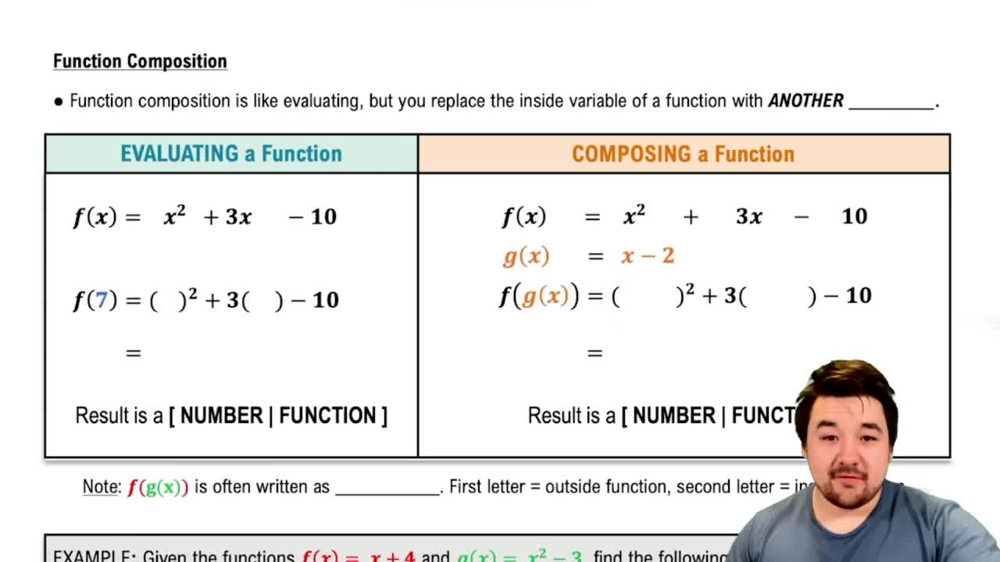
Function composition involves combining two functions to create a new function. If f(x) and g(x) are two functions, the composition (fog)(x) means applying g first and then f to the result, expressed as f(g(x)). Understanding this concept is crucial for solving the problem, as it requires evaluating the functions in a specific order.
Evaluating functions means substituting a specific input value into the function to find the output. For example, to evaluate f(2) for f(x) = 4 - x, you would replace x with 2, resulting in f(2) = 4 - 2 = 2. This skill is essential for calculating the values of (fog)(2) and (go f)(2) in the given problem.
A quadratic function is a polynomial function of degree two, typically expressed in the form g(x) = ax² + bx + c. In this problem, g(x) = 2x² + x + 5 is a quadratic function. Understanding its properties, such as its shape (a parabola) and how to manipulate it, is important for performing the composition with f(x) and evaluating the results.

 2:34 minutes
 Verified step by step guidance
 4:56
4:56