Exercises 73–75 will help you prepare for the material covered in the next section. Simplify: √18 - √8
Verified step by step guidance
1
Identify the radicals to simplify: \( \sqrt{18} - \sqrt{8} \).
Express each radicand as a product of a perfect square and another factor: \( 18 = 9 \times 2 \) and \( 8 = 4 \times 2 \).
Rewrite each square root using the property \( \sqrt{a \times b} = \sqrt{a} \times \sqrt{b} \): \( \sqrt{18} = \sqrt{9} \times \sqrt{2} \) and \( \sqrt{8} = \sqrt{4} \times \sqrt{2} \).
Simplify the square roots of the perfect squares: \( \sqrt{9} = 3 \) and \( \sqrt{4} = 2 \), so the expression becomes \( 3\sqrt{2} - 2\sqrt{2} \).
Combine like terms by subtracting the coefficients of \( \sqrt{2} \): \( (3 - 2)\sqrt{2} \).
Verified video answer for a similar problem:
This video solution was recommended by our tutors as helpful for the problem above
Video duration:
2m
Play a video:
0 Comments
Key Concepts
Here are the essential concepts you must grasp in order to answer the question correctly.
Simplifying Square Roots
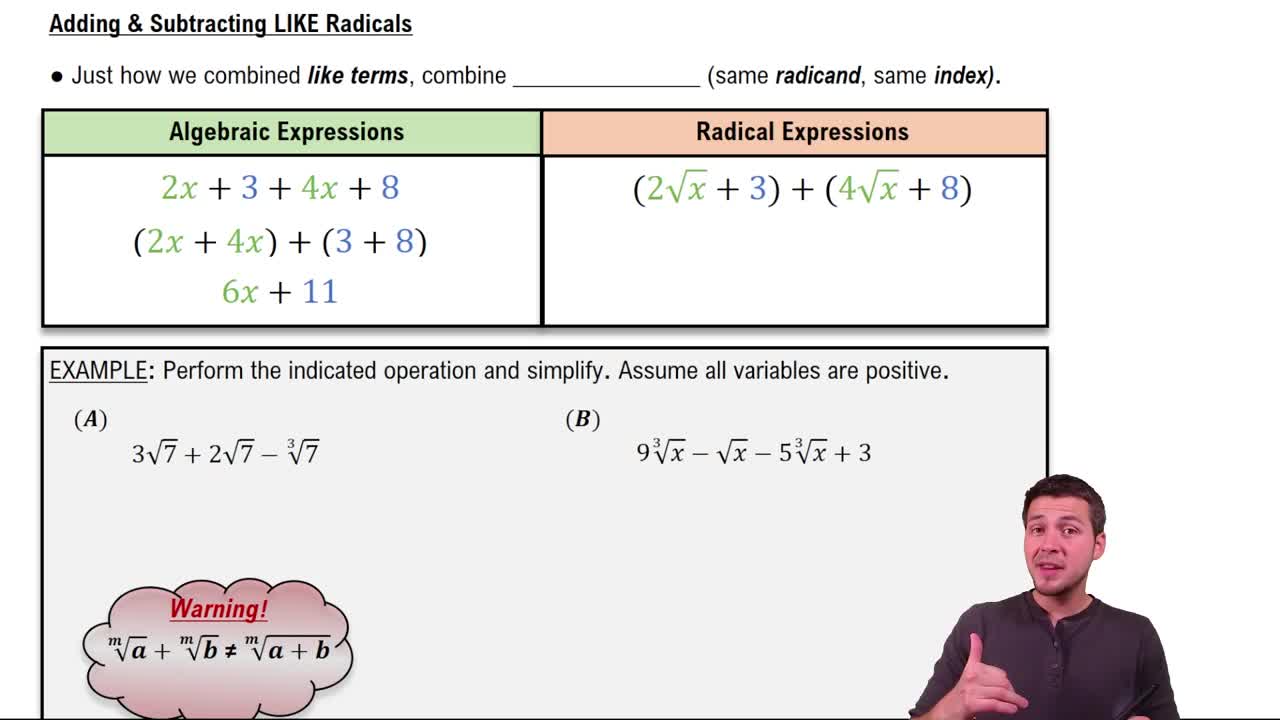
Simplifying square roots involves expressing the radicand as a product of perfect squares and other factors. For example, √18 can be rewritten as √(9×2), which simplifies to 3√2 because √9 is 3. This process makes it easier to combine or subtract roots.
Like radicals have the same radicand and index, allowing them to be combined through addition or subtraction. For instance, 3√2 and 5√2 are like radicals and can be combined as (3 - 5)√2 = -2√2. Recognizing like radicals is essential for simplifying expressions involving roots.
To subtract radicals, first simplify each radical and then combine like radicals by subtracting their coefficients. If the radicals are not like terms, they cannot be combined further. For example, √18 - √8 simplifies to 3√2 - 2√2, which equals √2.

 2:36 minutes
 Verified step by step guidance
 02:20
02:20