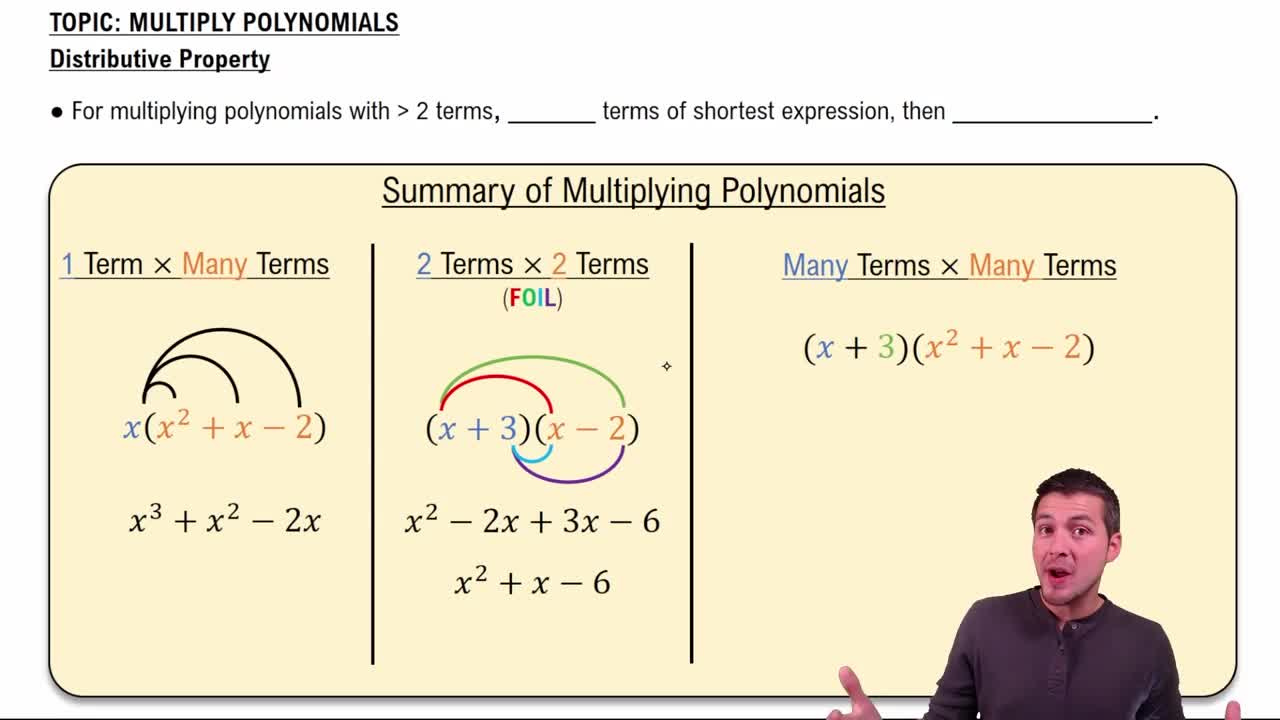
Start by expanding the squared term in the expression: expand \$2(x+h)^2\( using the formula for a binomial square, which is \)(a+b)^2 = a^2 + 2ab + b^2\(. So, write \)2(x+h)^2\( as \)2(x^2 + 2xh + h^2)$.
Distribute the 2 across each term inside the parentheses: \(2 \times x^2\), \(2 \times 2xh\), and \(2 \times h^2\), resulting in \$2x^2 + 4xh + 2h^2$.
Next, distribute the 3 across the terms in \$3(x+h)\(: \(3 \times x\) and \(3 \times h\), which gives \)3x + 3h$.
Rewrite the entire expression by substituting the expanded parts and then combine like terms: \$2x^2 + 4xh + 2h^2 + 3x + 3h + 5 - (2x^2 + 3x + 5)$.
Finally, remove the parentheses in the subtraction by distributing the negative sign and combine like terms carefully: subtract \$2x^2\(, \)3x\(, and \)5$ from the corresponding terms, then simplify the resulting expression.
Verified video answer for a similar problem:
This video solution was recommended by our tutors as helpful for the problem above
Video duration:
4m
Play a video:
0 Comments
Key Concepts
Here are the essential concepts you must grasp in order to answer the question correctly.
Polynomial Expansion
Polynomial expansion involves multiplying out expressions like (x + h)² to rewrite them as a sum of terms. For example, (x + h)² expands to x² + 2xh + h². This step is essential to simplify and combine like terms in the given expression.
Combining like terms means adding or subtracting terms with the same variable and exponent. After expanding, terms such as x², x, and constants are grouped together to simplify the expression into a more manageable form.
The distributive property allows multiplication over addition or subtraction, such as multiplying 2 by each term inside (x + h)². This property is used to remove parentheses and simplify expressions step-by-step.

 4:41 minutes
 Verified step by step guidance
 05:13
05:13