For each function, find (a)ƒ(x+h), (b)ƒ(x+h)-ƒ(x), and (c)[ƒ(x+h)-ƒ(x)]/h.See Example 4.
Verified step by step guidance
1
Start by identifying the given function: \(f(x) = -4x + 2\).
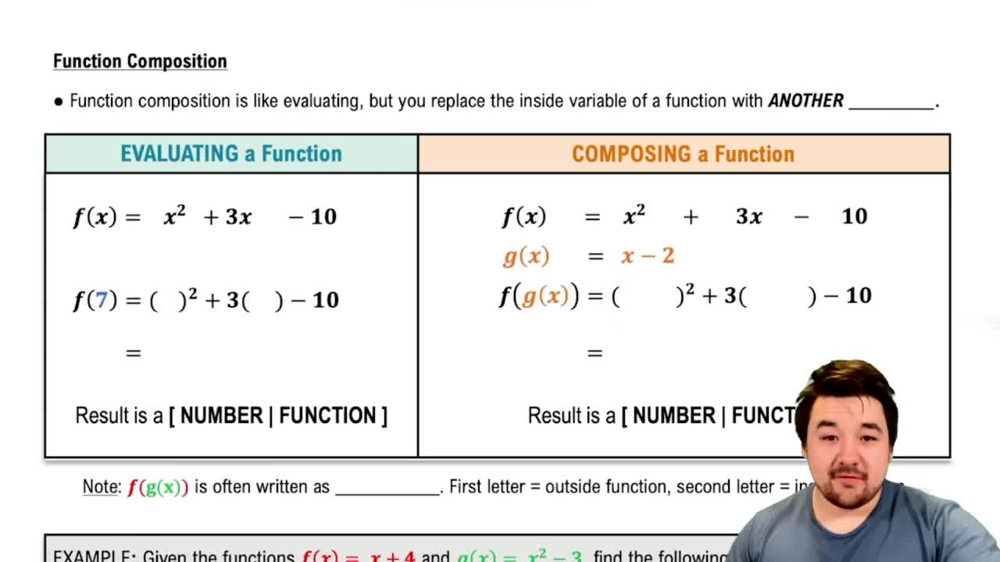
To find \(f(x+h)\), substitute \(x+h\) into the function in place of \(x\). This means replacing every \(x\) in the expression with \((x+h)\), so write \(f(x+h) = -4(x+h) + 2\).
Next, find \(f(x+h) - f(x)\) by subtracting the original function \(f(x)\) from the expression you found for \(f(x+h)\). This gives \(f(x+h) - f(x) = [-4(x+h) + 2] - [-4x + 2]\).
Simplify the expression \(f(x+h) - f(x)\) by distributing and combining like terms carefully. This will help you see the difference in terms of \(h\).
Finally, to find \(\frac{f(x+h) - f(x)}{h}\), divide the simplified expression from the previous step by \(h\). This expression is important because it represents the average rate of change of the function over the interval from \(x\) to \(x+h\).
Verified video answer for a similar problem:
This video solution was recommended by our tutors as helpful for the problem above
Video duration:
3m
Play a video:
0 Comments
Key Concepts
Here are the essential concepts you must grasp in order to answer the question correctly.
Function Notation and Evaluation
Function notation, such as ƒ(x), represents a rule that assigns each input x to an output. Evaluating ƒ(x+h) means substituting x+h into the function in place of x, which helps analyze how the function behaves when its input changes by h.
The expression ƒ(x+h) - ƒ(x) calculates the change in the function's output as the input changes from x to x+h. This difference is fundamental in understanding how the function varies over an interval and is a step toward finding rates of change.
The difference quotient, [ƒ(x+h) - ƒ(x)] / h, measures the average rate of change of the function over the interval from x to x+h. It is a foundational concept in calculus, representing the slope of the secant line, and is used to approximate derivatives.

 3:56 minutes
 Verified step by step guidance
 4:26
4:26