Work each problem. Match each polynomial in Column I with its factored form in Column II.
Verified step by step guidance
1
Identify the type of factoring needed for each polynomial. Notice that all three are cubic expressions and resemble the sum or difference of cubes. Recall the formulas for factoring cubes:
Difference of cubes: \(a^3 - b^3 = (a - b)(a^2 + ab + b^2)\)
Sum of cubes: \(a^3 + b^3 = (a + b)(a^2 - ab + b^2)\)
For each polynomial, rewrite it in the form \(a^3 \pm b^3\) by expressing the terms as cubes. For example, \$8x^3 = (2x)^3\( and \)27 = 3^3$.
Apply the appropriate formula to factor each polynomial, then match the resulting factors with the options given in Column II by comparing the binomial and trinomial factors.
Verified video answer for a similar problem:
This video solution was recommended by our tutors as helpful for the problem above
Video duration:
2m
Play a video:
0 Comments
Key Concepts
Here are the essential concepts you must grasp in order to answer the question correctly.
Sum and Difference of Cubes
This concept involves factoring expressions of the form a³ + b³ or a³ - b³. The sum of cubes factors as (a + b)(a² - ab + b²), while the difference of cubes factors as (a - b)(a² + ab + b²). Recognizing these patterns helps in breaking down cubic polynomials into simpler binomial and trinomial factors.
To factor cubic expressions, it is essential to correctly identify the cube roots 'a' and 'b' from terms like 8x³ and 27. For example, 8x³ = (2x)³ and 27 = 3³. Correct identification allows the application of sum or difference of cubes formulas accurately.
After factoring, it is important to verify which factored form corresponds to each original polynomial by expanding or comparing terms. This ensures the correct pairing between the polynomial and its factorization, especially when signs and order of terms affect the factors.

 2:45 minutes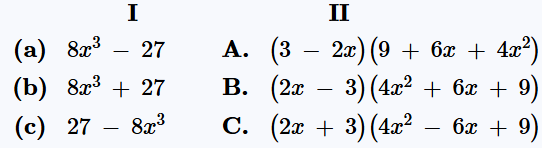
 Verified step by step guidance
 03:41
03:41