Factor each trinomial, if possible. See Examples 3 and 4. (2p+q)2-10(2p+q)+25
Verified step by step guidance
1
Recognize that the expression is a quadratic in terms of the binomial \( (2p + q) \). Let \( x = (2p + q) \) to simplify the expression.
Rewrite the expression using \( x \): \( x^2 - 10x + 25 \). This is now a standard quadratic trinomial.
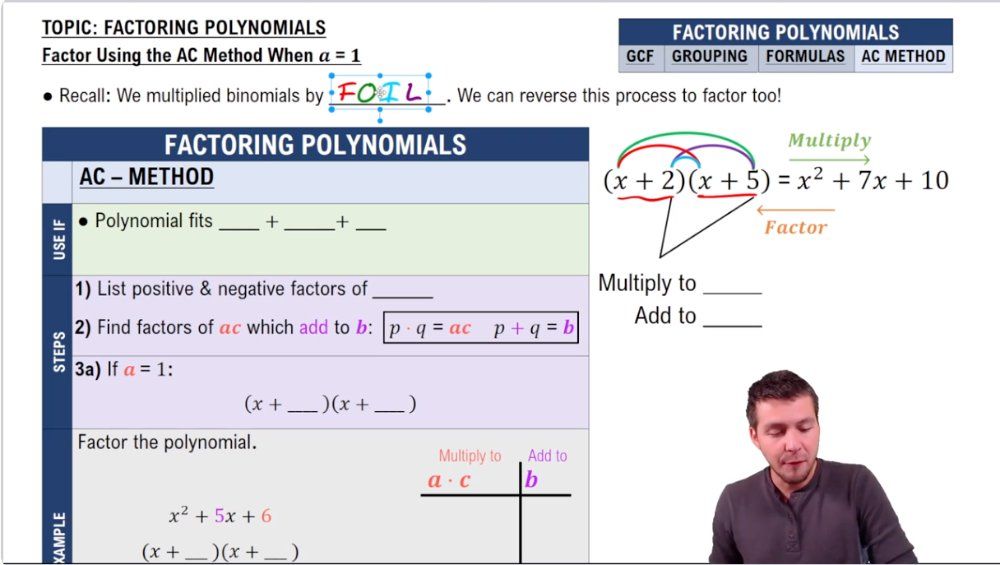
Look for two numbers that multiply to the constant term (25) and add up to the coefficient of \( x \) (-10). These numbers are both -5 because \( -5 \times -5 = 25 \) and \( -5 + -5 = -10 \).
Use these numbers to factor the quadratic as a perfect square trinomial: \( (x - 5)^2 \).
Substitute back \( x = (2p + q) \) to get the factored form: \( ((2p + q) - 5)^2 \).
Verified video answer for a similar problem:
This video solution was recommended by our tutors as helpful for the problem above
Video duration:
2m
Play a video:
0 Comments
Key Concepts
Here are the essential concepts you must grasp in order to answer the question correctly.
Recognizing Quadratic Expressions
A quadratic expression is a polynomial of degree two, typically in the form ax^2 + bx + c. In this problem, the expression is written in terms of a binomial (2p + q), which can be treated as a single variable to simplify factoring.
Solving Quadratic Equations Using The Quadratic Formula
Factoring Perfect Square Trinomials
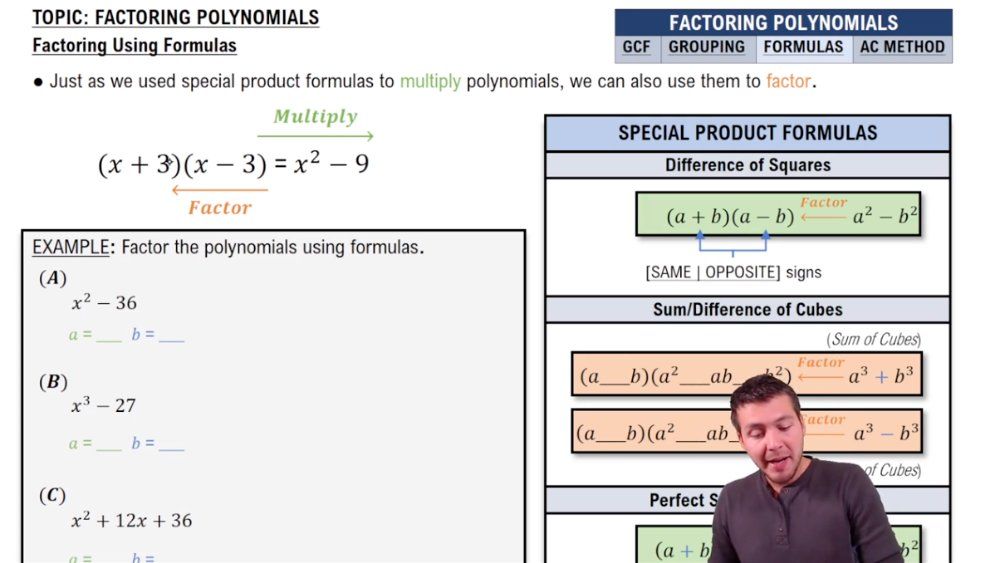
A perfect square trinomial takes the form (a ± b)^2 = a^2 ± 2ab + b^2. Identifying this pattern helps factor expressions quickly. Here, the trinomial resembles (2p + q)^2 - 10(2p + q) + 25, which can be seen as (2p + q - 5)^2.
Substitution involves temporarily replacing a complex expression with a single variable to simplify the factoring process. By letting x = (2p + q), the trinomial becomes x^2 - 10x + 25, which is easier to factor before substituting back.

 2:36 minutes
 Verified step by step guidance
 06:36
06:36