Factor each trinomial, if possible. See Examples 3 and 4.
Verified step by step guidance
1
Identify the trinomial to factor: \$12s^2 + 11st - 5t^2$.
Multiply the coefficient of \(s^2\) (which is 12) by the constant term (which is \(-5\)), giving \(12 \times (-5) = -60\).
Find two numbers that multiply to \(-60\) and add up to the middle coefficient, which is 11. These two numbers will help split the middle term.
Rewrite the middle term \$11st\( as the sum of two terms using the two numbers found, for example: \)as t + bs t\(, where \)a\( and \)b$ are the numbers from the previous step.
Group the four terms into two pairs and factor out the greatest common factor (GCF) from each pair, then factor out the common binomial factor to complete the factoring.
Verified video answer for a similar problem:
This video solution was recommended by our tutors as helpful for the problem above
Video duration:
6m
Play a video:
0 Comments
Key Concepts
Here are the essential concepts you must grasp in order to answer the question correctly.
Factoring Trinomials
Factoring trinomials involves rewriting a quadratic expression as a product of two binomials. For trinomials in the form ax^2 + bx + c, the goal is to find two binomials whose product equals the original expression. This process simplifies solving equations and analyzing functions.
When the leading coefficient (a) is not 1, factoring often requires multiplying a and c, then finding two numbers that multiply to ac and add to b. These numbers help split the middle term, allowing the expression to be factored by grouping. This method is essential for trinomials like 12s^2 + 11st - 5t^2.
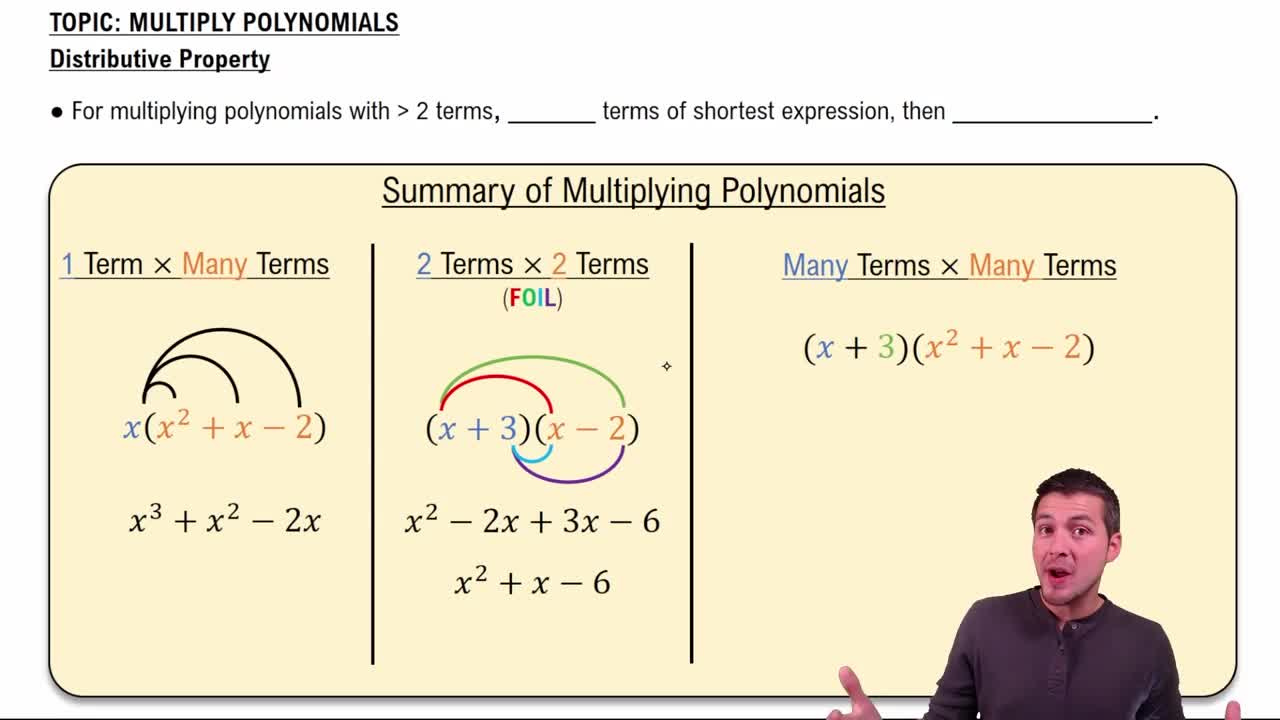
Multiply Polynomials Using the Distributive Property
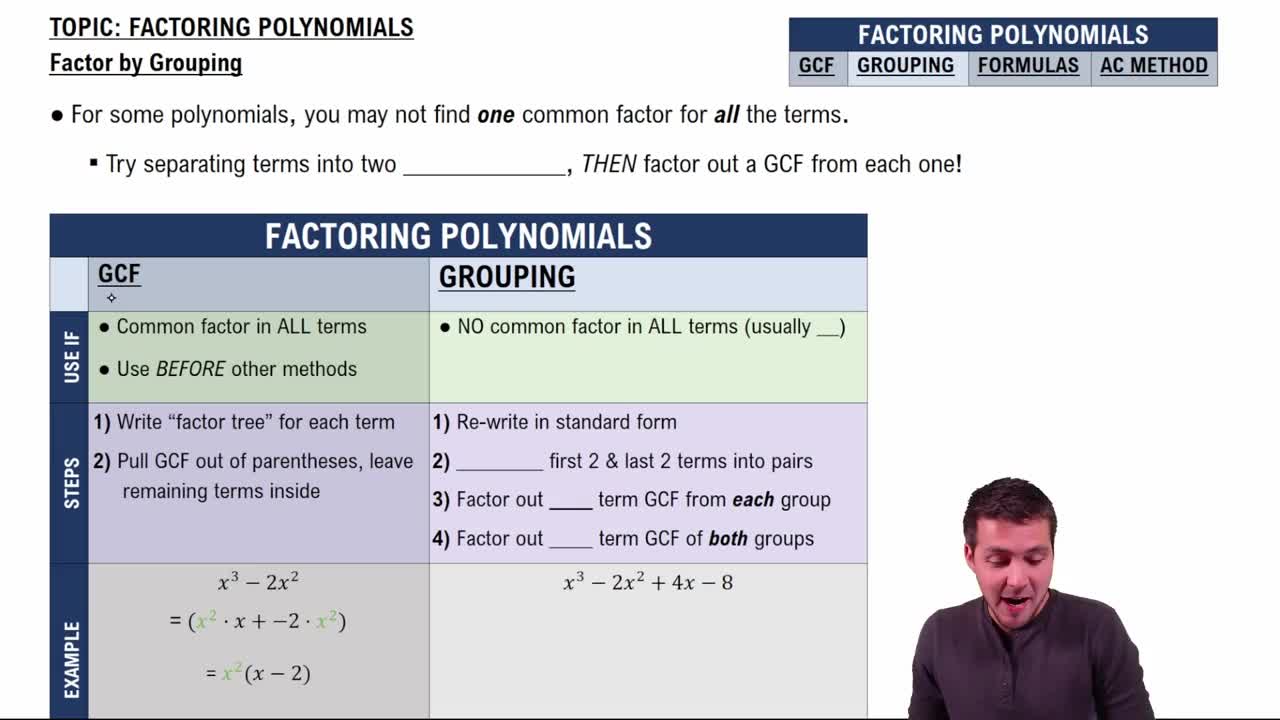
Factoring by Grouping
Factoring by grouping involves grouping terms with common factors after splitting the middle term. Each group is factored separately, and a common binomial factor is factored out. This technique is crucial for factoring complex trinomials where simple methods do not apply.

 6:30 minutes
 Verified step by step guidance
 6:29
6:29