If 5 times a number is decreased by 4, the principal square root of this difference is 2 less than the number. Find the number(s).
Ch. 1 - Equations and Inequalities

Chapter 2, Problem 108
If a number is decreased by 3, the principal square root of this difference is 5 less than the number. Find the number(s).
Verified step by step guidance1
Let the number be represented by the variable \(x\).
Translate the problem statement into an equation: "If a number is decreased by 3" becomes \(x - 3\), and "the principal square root of this difference is 5 less than the number" becomes \(\sqrt{x - 3} = x - 5\).
Square both sides of the equation to eliminate the square root: \((\sqrt{x - 3})^2 = (x - 5)^2\), which simplifies to \(x - 3 = (x - 5)^2\).
Expand the right side: \((x - 5)^2 = x^2 - 10x + 25\), so the equation becomes \(x - 3 = x^2 - 10x + 25\).
Rearrange the equation to standard quadratic form by moving all terms to one side: \(0 = x^2 - 10x + 25 - x + 3\), which simplifies to \(0 = x^2 - 11x + 28\). This quadratic equation can now be solved for \(x\).

Verified video answer for a similar problem:
This video solution was recommended by our tutors as helpful for the problem above.
Video duration:
5mWas this helpful?
Key Concepts
Here are the essential concepts you must grasp in order to answer the question correctly.
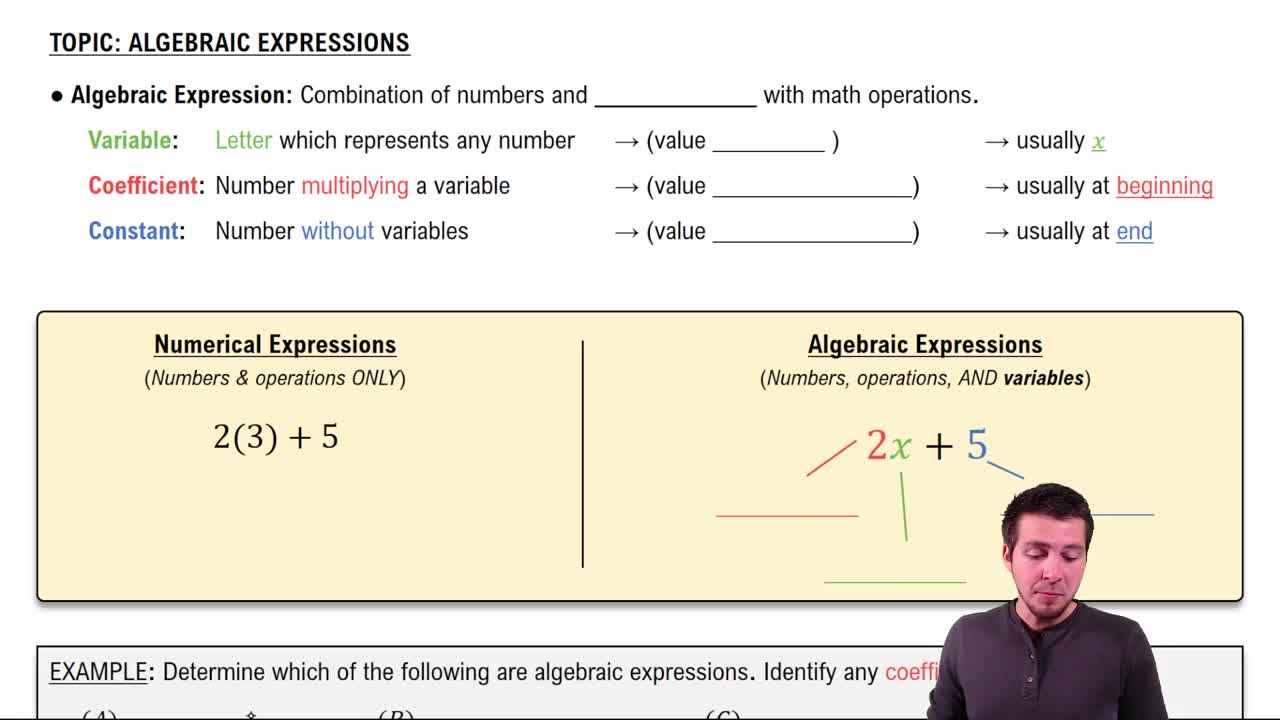
Setting up Algebraic Equations
This involves translating a word problem into an algebraic equation using variables to represent unknown quantities. Identifying relationships described in the problem allows you to form equations that can be solved systematically.
Recommended video:
Guided course
Introduction to Algebraic Expressions
Square Roots and Principal Square Root
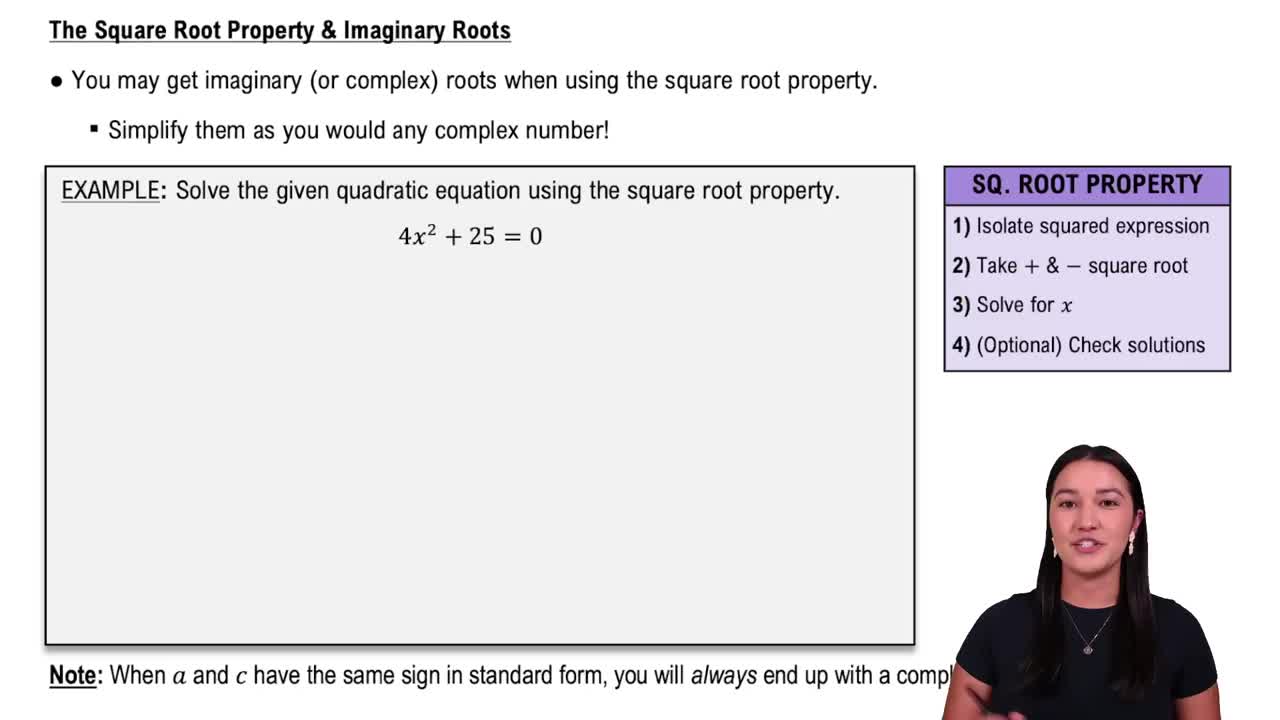
The principal square root of a number is the non-negative root. Understanding how to work with square roots, including isolating the root and squaring both sides of an equation, is essential for solving equations involving roots.
Recommended video:
Imaginary Roots with the Square Root Property
Solving Quadratic Equations
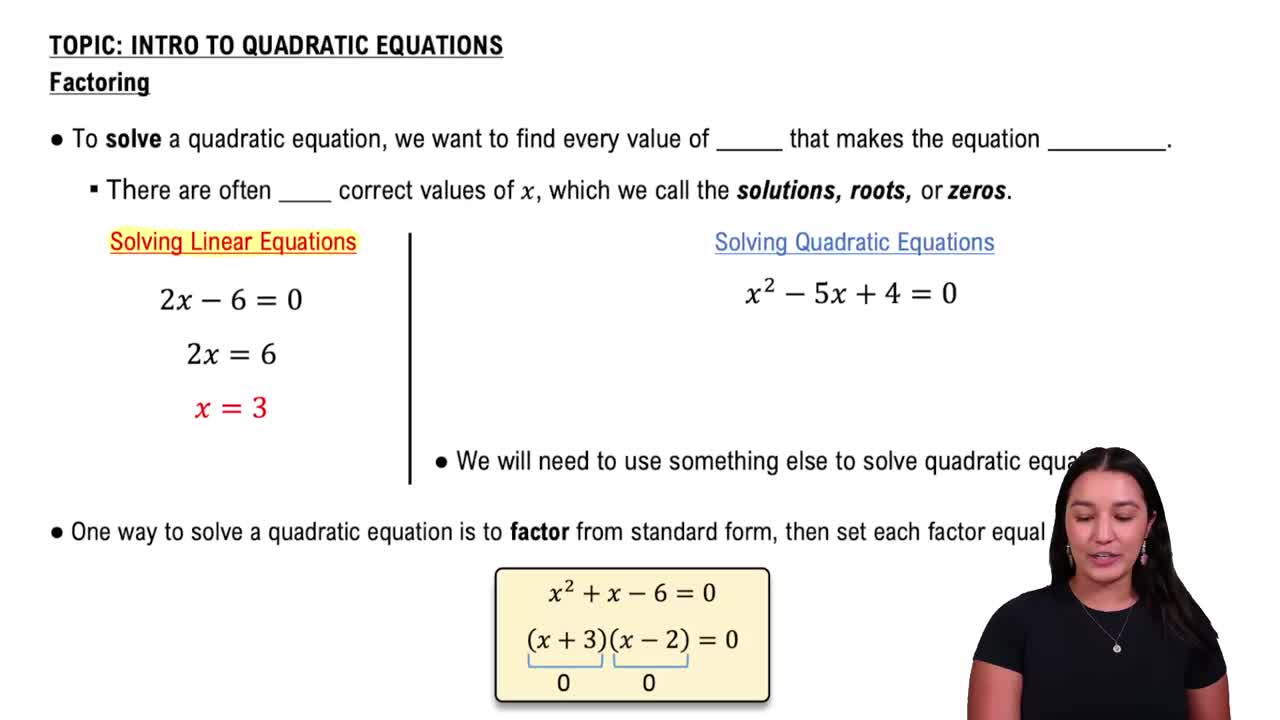
After forming an equation, you may need to rearrange it into a quadratic form and solve using factoring, completing the square, or the quadratic formula. Checking solutions is important because squaring can introduce extraneous roots.
Recommended video:
Solving Quadratic Equations by Factoring
Related Practice
Textbook Question
838
views
Textbook Question
Solve each equation in Exercises 83–108 by the method of your choice. 3/(x - 3) + 5/(x - 4) = (x2 - 20)/(x2 - 7x + 12)
954
views
Textbook Question
Solve each equation in Exercises 83–108 by the method of your choice. 2x/(x - 3) + 6/(x + 3) = - 28/(x2 - 9)
892
views
Textbook Question
In Exercises 109–114, find the x-intercept(s) of the graph of each equation. Use the x-intercepts to match the equation with its graph. The graphs are shown in [- 10, 10, 1] by [- 10, 10, 1] viewing rectangles and labeled (a) through (f). y = x2 - 4x - 5
915
views
Textbook Question
When 4 times a number is subtracted from 5, the absolute value of the difference is at most 13. Use interval notation to express the set of all numbers that satisfy this condition.
858
views
Textbook Question
In Exercises 107–110, use graphs to find each set. [1,3) ∩ (0,4)
509
views