If 5 times a number is decreased by 4, the principal square root of this difference is 2 less than the number. Find the number(s).
Ch. 1 - Equations and Inequalities

Chapter 2, Problem 108
Solve each equation in Exercises 83–108 by the method of your choice. 3/(x - 3) + 5/(x - 4) = (x2 - 20)/(x2 - 7x + 12)
Verified step by step guidance1
Step 1: Analyze the equation and identify the denominators. The denominators are (x - 3), (x - 4), and (x^2 - 7x + 12). Factorize the quadratic denominator x^2 - 7x + 12 into (x - 3)(x - 4). This simplifies the equation to: 3/(x - 3) + 5/(x - 4) = (x^2 - 20)/((x - 3)(x - 4)).
Step 2: Determine the least common denominator (LCD) for all terms. The LCD is (x - 3)(x - 4). Rewrite each term in the equation with this common denominator.
Step 3: Rewrite the left-hand side of the equation. Multiply the numerator and denominator of 3/(x - 3) by (x - 4), and multiply the numerator and denominator of 5/(x - 4) by (x - 3). This gives: (3(x - 4) + 5(x - 3))/((x - 3)(x - 4)).
Step 4: Combine the left-hand side into a single fraction. Expand the numerators: 3(x - 4) becomes 3x - 12, and 5(x - 3) becomes 5x - 15. Add these together to get (3x - 12 + 5x - 15)/((x - 3)(x - 4)) = (8x - 27)/((x - 3)(x - 4)).
Step 5: Set the left-hand side equal to the right-hand side. Now the equation is: (8x - 27)/((x - 3)(x - 4)) = (x^2 - 20)/((x - 3)(x - 4)). Since the denominators are the same, equate the numerators: 8x - 27 = x^2 - 20. Rearrange this into a standard quadratic equation: x^2 - 8x + 7 = 0. Solve this quadratic equation using factoring, completing the square, or the quadratic formula.

Verified video answer for a similar problem:
This video solution was recommended by our tutors as helpful for the problem above.
Video duration:
3mWas this helpful?
Key Concepts
Here are the essential concepts you must grasp in order to answer the question correctly.
Rational Expressions
Rational expressions are fractions where the numerator and denominator are polynomials. Understanding how to manipulate these expressions, including finding common denominators and simplifying, is crucial for solving equations involving them. In this problem, the presence of rational expressions requires careful handling to combine and solve the equation effectively.
Recommended video:
Guided course
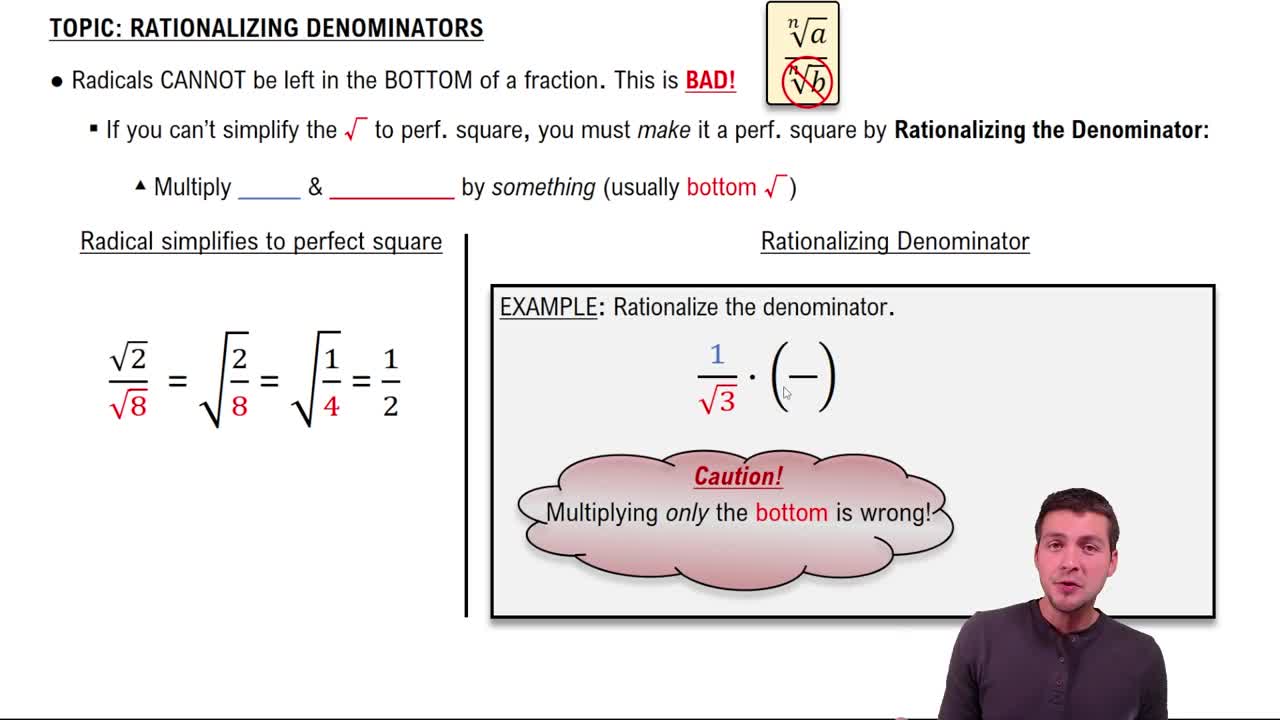
Rationalizing Denominators
Finding Common Denominators
To solve equations involving rational expressions, it is often necessary to find a common denominator. This process allows for the combination of fractions into a single expression, making it easier to isolate variables. In the given equation, identifying the least common denominator will facilitate the simplification and solution of the equation.
Recommended video:
Guided course
Rationalizing Denominators
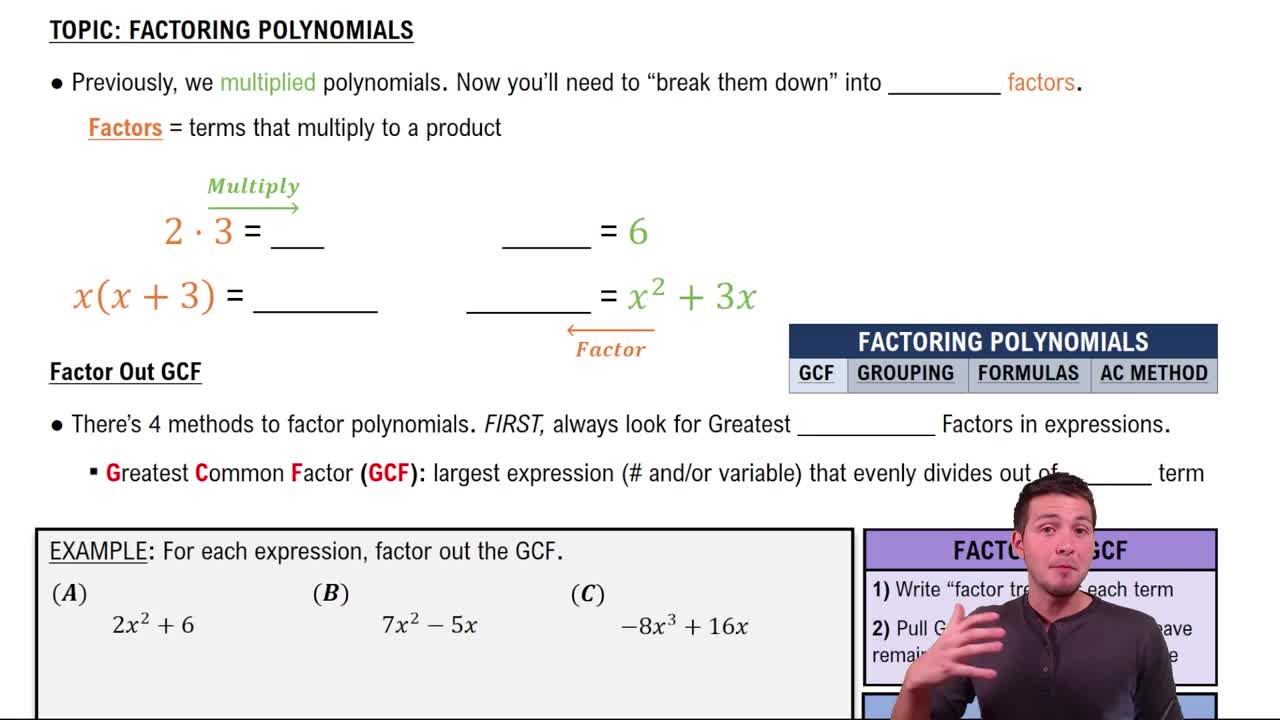
Factoring Polynomials
Factoring polynomials is the process of breaking down a polynomial into simpler components, or factors, that can be multiplied together to yield the original polynomial. This concept is essential in solving equations, particularly when simplifying expressions or finding roots. In this problem, factoring the quadratic expression in the numerator and the denominator will help in simplifying the equation and finding the values of x.
Recommended video:
Guided course
Introduction to Factoring Polynomials
Related Practice
Textbook Question
838
views
Textbook Question
If a number is decreased by 3, the principal square root of this difference is 5 less than the number. Find the number(s).
728
views
Textbook Question
In Exercises 107–110, use graphs to find each set. (-2,1] ∩ [-1,3)
521
views
Textbook Question
Solve each equation in Exercises 83–108 by the method of your choice. 2x/(x - 3) + 6/(x + 3) = - 28/(x2 - 9)
892
views
Textbook Question
In Exercises 109–114, find the x-intercept(s) of the graph of each equation. Use the x-intercepts to match the equation with its graph. The graphs are shown in [- 10, 10, 1] by [- 10, 10, 1] viewing rectangles and labeled (a) through (f). y = x2 - 4x - 5
915
views
Textbook Question
When 4 times a number is subtracted from 5, the absolute value of the difference is at most 13. Use interval notation to express the set of all numbers that satisfy this condition.
858
views